The Role of Materials Science in Durable Label Performance
Understanding the performance advantages, limitations, and ideal applications for today's industrial labeling systems is essential.
Need to Know
- Long-term performance of labels depends on matching the adhesive, facestock, topcoat, and application design to specific substrates and environmental conditions.
- Heat, chemicals, moisture, UV exposure, abrasion, and challenging substrates can cause conventional labels to peel, fade, crack, or detach.
- Peel adhesion, chemical resistance, UV exposure, abrasion, weather resistance, and water immersion testing can determine whether labels will withstand expected operating conditions.
- Unreadable or detached labels can create traceability gaps, compliance concerns, production disruptions, and worker safety risks.
Throughout heavy industry and the realm of materials science, label adhesion is more than a simple packaging concern. Often underestimated, label performance failures can trigger a domino effect of challenges, including traceability gaps, compliance risks, production disruptions, and increased safety concerns.
That’s why it’s becoming critical to work with a durable label partner that has proven expertise in materials science and research and development. Finding the right partner means your durable labels can be uniquely designed to withstand the harshest environments, the most complex substrates, and the most demanding application conditions. Ensuring reliable label performance across complex materials and environmental conditions has become a critical challenge for engineers, formulators, and operations teams alike. Durable labels stand up where common labels simply cannot perform. That’s because of the rigorous development and testing process used to engineer durable labels.
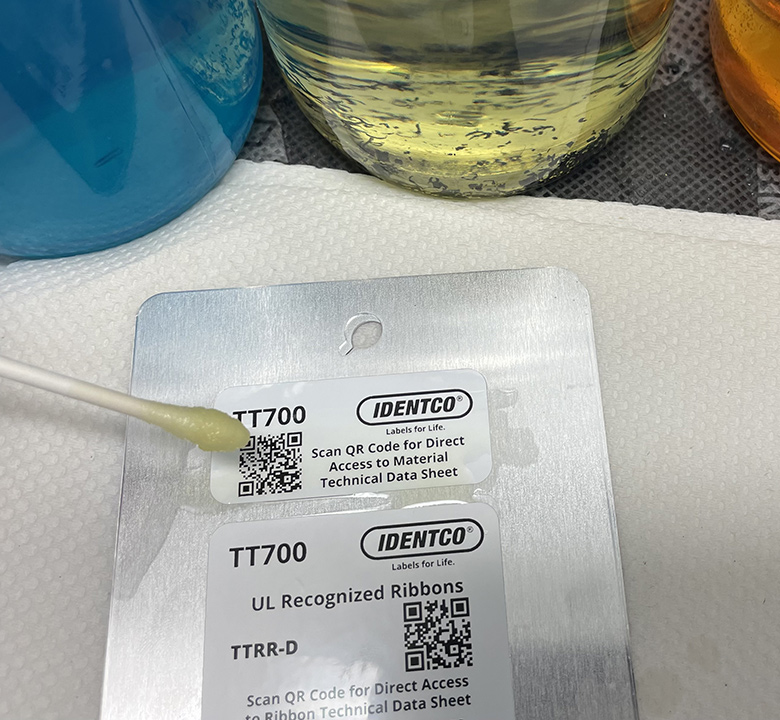
Image courtesy of Armis
Why Common Labels Fail in Industrial Environments
While general-purpose labels may perform well in controlled settings for short amounts of time, they are rarely engineered to withstand harsh industrial environments. Exposure to heat, moisture, chemicals, UV light, abrasion, oils, and fluctuating temperatures can quickly compromise conventional label materials and adhesive systems. In manufacturing facilities, warehouses, laboratories and outdoor applications, prime labels often begin to peel, fade, smear, crack or detach entirely, especially when applied to challenging substrates like textured metals, plastics, powder-coated surfaces, or low-surface-energy materials.
Durable labels and tags are specifically engineered for long-term performance in harsh environments. They use high performance materials like polyimide, polycarbonate, and polyester. The highest-performing labels can withstand temperatures of up to 220 °C+. To maximize long-term durability, each label or tag should be paired with the appropriate wax resin ribbon or printer technology, ensuring critical information remains legible and reliable throughout the product lifecycle.
The Importance of Materials Science
Durable label performance is ultimately a materials science challenge. The effectiveness of a label depends on selecting the right combination of adhesive, facestock material, topcoat, and application design for the intended environment.
Determining the right adhesive and facestock material begins with an evaluation of the label’s real-world environment and performance requirements. Materials science experts assess factors such as surface type, temperature exposure, chemical contact, UV exposure, abrasion, moisture, outdoor durability, and expected product lifespan to design the best construction for long-term performance. The facestock must maintain readability and structural integrity under harsh conditions, while the adhesive must bond securely to the specific substrate throughout the product lifecycle without peeling, lifting, or degrading. Variables such as textured versus smooth surfaces, low- versus high-surface-energy plastics, and application methods also influence material selection. Facestocks can be rigid, semi-flexible, or flexible depending on the application.
Once the appropriate facestock is selected, the right pressure-sensitive adhesive needs to be paired with it. The primary adhesive types and their unique applications may include:
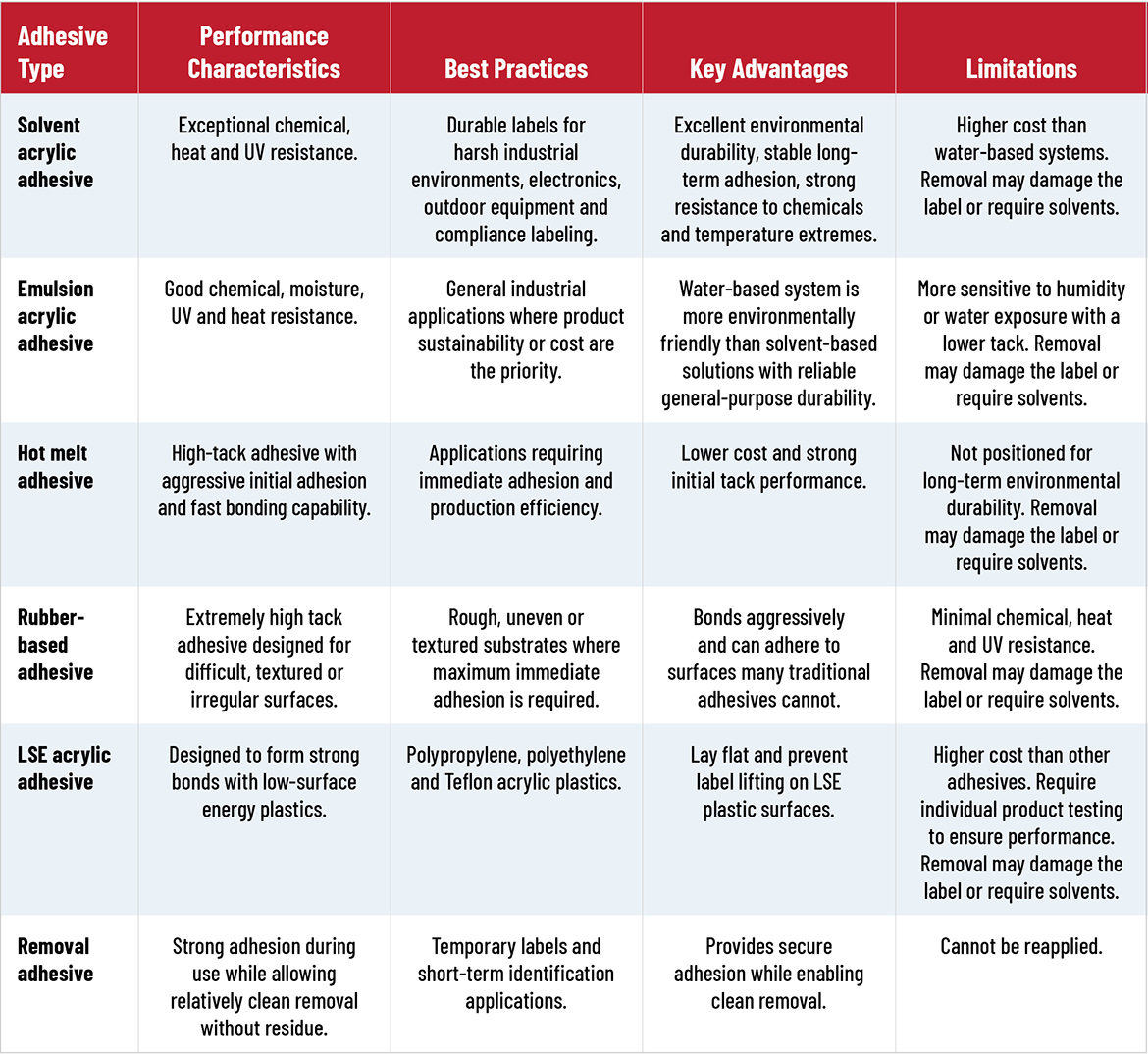
Table 1. Label adhesive types and their characteristics and applications. Source: Table courtesy of Armis.
Common Testing Methods
Each durable label or tag must go through a testing process that's designed to replicate real-world applications and validate material performance. Your durable label partner should be able to validate label constructions through application-specific testing that simulates the actual surfaces, environmental conditions, and customer-based operational demands. There are a few tests that accomplish these goals.
Chemical resistance testing evaluates how pressure-sensitive materials and printing inks withstand exposure to aggressive substances such as battery acid fluid, acetone, isopropyl alcohol and bleach, with labels measured against customer requirements and industry standards for permanency and legibility.
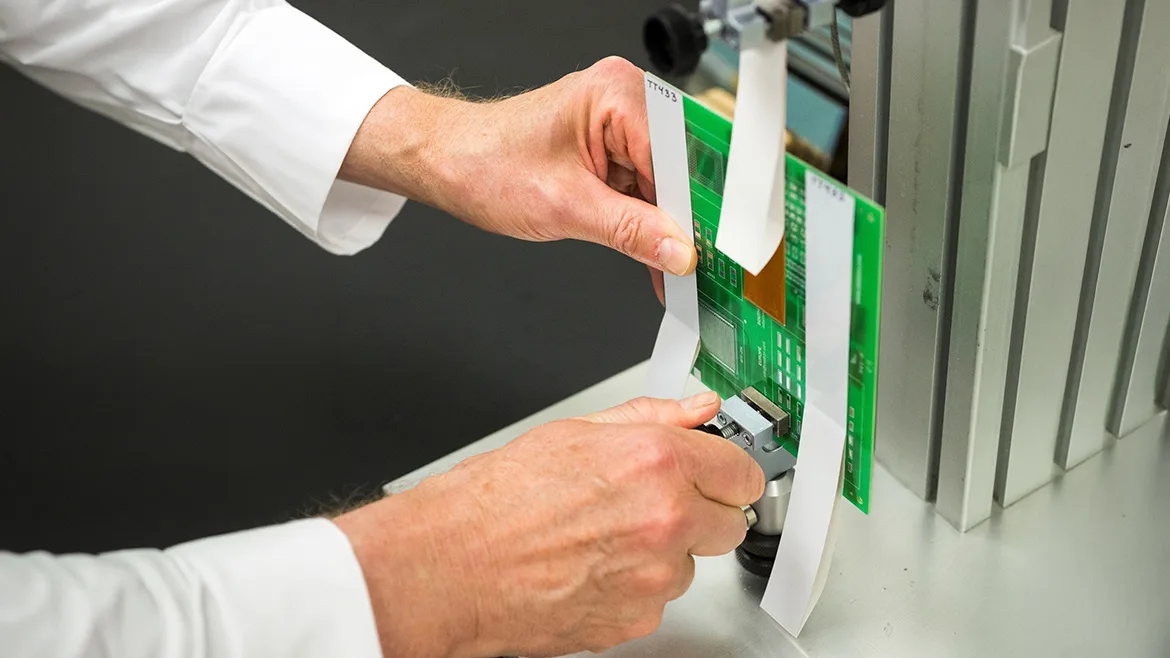
Peel adhesion testing determines the amount of force required to remove a label from a specific substrate at a 180-degree angle, helping engineers understand long-term bond performance across various materials and surface energies.
Accelerated UV exposure testing further assesses durability by placing labels inside xenon arc chambers that emulate years of sunlight exposure in compressed timeframes. During testing, materials are evaluated for shrinkage, lifting, curling, and yellowing while printed graphics are analyzed for color retention and readability.
Abrasion resistance is tested using weighted abrasive wheels that repeatedly rub label surfaces to simulate wear from handling, friction, and industrial use.
Weather resistance tests expose labels to both sustained and fluctuating temperatures in temperature cycling chambers to validate performance under thermal stress, while water immersion testing evaluates resistance to lifting, cracking, shrinking, and delamination during prolonged submersion.
Together, these testing protocols help validate durable labels that are not only designed for extreme environments but proven to perform in them. Without testing and validation, labels will not be verified to withstand their environments.
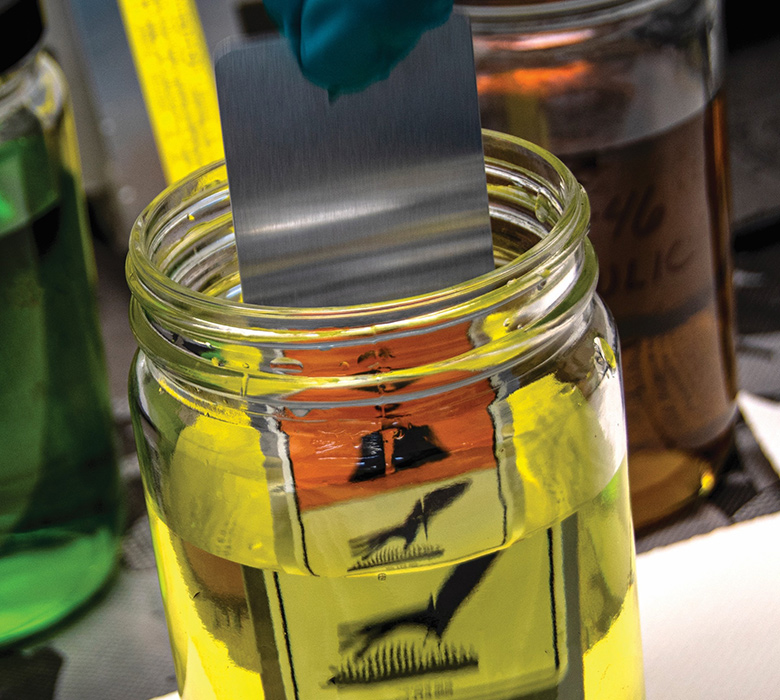
Image courtesy of Armis
The Hidden Risks of Label Failure
Once a label fails, the impacts will be felt immediately. A failed label compromises traceability when critical identifying information becomes unreadable, detached, or inaccurate during the lifecycle of a product or component. In industrial environments, labels often carry essential data such as serial numbers, barcodes, QR codes, compliance markings, hazard warnings, production dates, and lot tracking information.
Many industrial labels also contain mandatory information such as hazard warnings, safety instructions, certification markings, lot numbers, serial numbers, and compliance identifiers required by organizations like the Occupational Safety and Health Administration (OSHA) and the Globally Harmonized System (GHS). If a label fails or becomes illegible due to environmental exposure or adhesive failure, that information may no longer meet compliance standards, even if the product itself remains functional.
This can create significant operational and legal consequences. During audits or inspections, missing or unreadable labels may result in failed compliance reviews, fines, or corrective action requirements.
A failed label can create immediate operational disruption by interrupting the flow of information that manufacturers rely on to keep production, maintenance, and compliance systems running efficiently. When labels become unreadable, detach from equipment, or fail under exposure to chemicals, abrasion, heat or moisture, employees may no longer be able to identify components, verify specifications, or track materials accurately through production.
Labels are also directly linked to the safety of workers. In industrial settings where employees interact daily with hazardous materials, energized equipment, and automated machinery, a failed warning or identification label can contribute to improper handling, maintenance errors, or exposure to unsafe conditions.
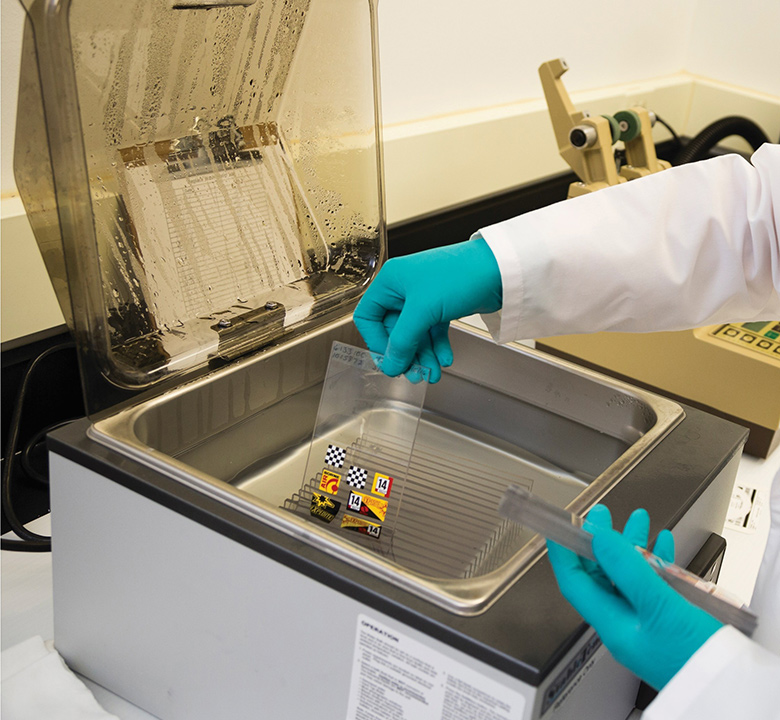
Image courtesy of Armis
Choosing the Right Partner
Across industrial manufacturing, labels are being treated less as consumable components and more as engineered performance systems that directly influence safety, compliance, and operational uptime. For formulators, converters, and adhesive manufacturers, that shift reflects the growing demands being placed on pressure-sensitive constructions in harsh application environments. Today’s durable labels must maintain adhesion, legibility and dimensional stability across exposure to aggressive chemicals, UV radiation, abrasion, thermal cycling, and low-surface-energy substrates, often for the full life of the product.
As automation and traceability requirements expand, labels have become integral to manufacturing infrastructure, carrying serialized data, compliance markings, and machine-readable codes that support production flow and regulatory accountability. This evolution is placing greater emphasis on adhesive chemistry, facestock engineering and application-specific material testing, driving manufacturers to collaborate more closely with durable label providers that possess deep materials science expertise. In many industrial applications, label performance is now viewed as a direct extension of overall system reliability.
Ultimately, label failure is not simply a labeling issue. It is an adhesion, materials science, and risk management problem with far-reaching operational consequences. For adhesive formulators, converters and manufacturers, the importance of finding a labeling partner that has application-specific engineering, rigorous testing, and long-term performance validation protocols is imperative.
As industrial environments continue to grow more demanding, durable label performance will increasingly depend on selecting the right materials, adhesive chemistry, and technical partner to mitigate risk before failure occurs.
For additional information about Armis Labels, visit https://armislabels.com.
Looking for a reprint of this article?
From high-res PDFs to custom plaques, order your copy today!