Closing the Accuracy Gap in Silicone Extractables Testing
How an XRF-based method can improve accuracy, accessibility and confidence in release coating quality control.
Need to Know
- XRF offers a more direct measurement approach by measuring silicon content in the extracted solvent.
- The method builds on familiar equipment, making implementation practical for facilities already using XRF.
- More reproducible data support better decisions across QC, R&D, operations, and technical service.
- Greater accuracy can improve troubleshooting, helping teams identify process variation while reducing unnecessary repeat testing.
Silicone extractables testing gives release coating manufacturers a critical view into coating consistency, process control, and downstream performance. In pressure-sensitive applications for medical, food-contact, and cosmetics markets, migration-related concerns can affect product qualification, customer confidence, and regulatory review. A release liner may meet coat weight targets while still raising performance questions if extractable silicone varies from one run to another or if the analytical method lacks enough precision to separate coating variation from testing variation.
As applications place tighter expectations on release systems, quality control teams need analytical methods that deliver accurate results without adding an impractical burden inside production environments. The challenge lies in applying high-precision analytical methods within routine plant workflows that require speed, reproducibility and reasonable implementation costs. Manufacturers need enough analytical accuracy to support quality control (QC) decisions, process optimization and customer troubleshooting, along with a workflow that production laboratories can adopt without major capital investment, dedicated operators, or lengthy sample preparation.
X-ray fluorescence, or XRF, offers a practical path since many silicone coating facilities have already invested in XRF equipment commonly used for coat weight measurement. An optimized XRF-based silicone extractables method builds on that installed base while moving beyond indirect coat weight loss calculations. By measuring silicon content in the solvent after extraction, the method can provide higher-resolution data through a workflow that remains accessible to facilities already familiar with XRF-based coating analysis. That combination of accuracy and practicality gives release coating manufacturers an exceptionally stronger tool for evaluating extractables, diagnosing process variation, and reducing trial-and-error troubleshooting.
Where Current Methods Create Trade-Offs
Release coating manufacturers have historically relied on several approaches to evaluate silicone extractables. The Oxford method remains common because it aligns with equipment coating plants already have. The method starts with an XRF coat weight measurement, places the measured sample in solvent, then measures the coat weight again after solvent exposure to determine how much silicone the coating lost. The method has gained adoption because it offers a straightforward and low-cost approach in plants that already use XRF for production checks.
That accessibility comes with limitations. The Oxford method can produce wide variance and may generate false high or false low results, especially when users need greater precision for regulated or high-sensitivity applications. Those results complicate quality decisions because the team may struggle to determine whether the test captured a real coating issue or introduced uncertainty through the measurement approach. In a high-throughput QC environment, that uncertainty can force additional testing, delay technical decisions or push teams toward process adjustments that do not address the actual source of variation.
Atomic absorption and inductively coupled plasma optical emission spectroscopy, or ICP-OES, can provide higher-accuracy elemental analysis in specialized lab environments. EPA Method 6010D describes multielement determinations by ICP-OES using sequential or simultaneous optical systems and axial or radial viewing of the plasma.1 That analytical capability can serve technical applications, although it often requires higher capital and operating costs, longer analysis time, more extensive sample preparation, and dedicated operators. In release coating facilities, those requirements can make AA or ICP-OES difficult to justify for routine extractables testing, even when the analytical performance has clear value.
Production and technical teams often face a practical tension between familiar plant methods and more sophisticated lab methods. A low-cost method may lack the precision needed for difficult troubleshooting or highly regulated applications. A more sophisticated method may sit outside the facility’s normal equipment base and workflow. An XRF-based solvent measurement approach helps close that gap by using familiar instrumentation, supporting direct silicon measurement in the solvent, and avoiding several implementation barriers associated with AA or ICP-OES.
How XRF Changes the Measurement Approach
XRF already has an established role in coating analysis because it can measure elemental signal and support coating weight or coating thickness control. ASTM B568-98(2021), for example, covers the use of X-ray spectrometry to determine the thickness of metallic and some nonmetallic coatings.2 In silicone release coating operations, XRF has become a familiar production tool because it can support coat weight measurement on coated paper and plastic substrates. The WACKER method extends that familiarity into extractables testing by changing where the measurement occurs.
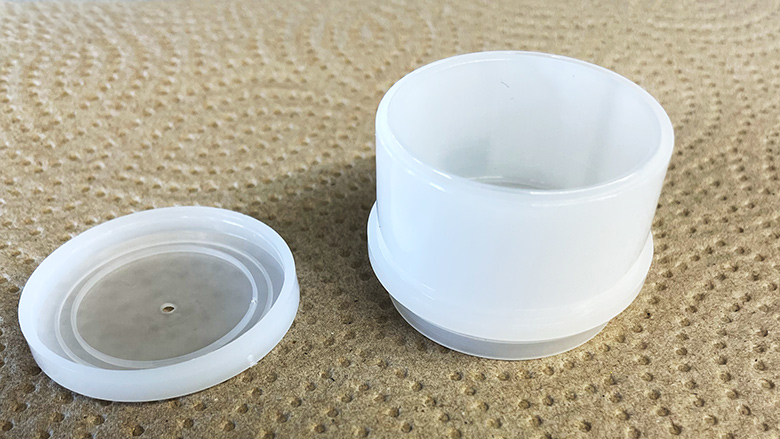
The optimized method measures silicon content in the extracted solvent rather than relying only on coating weight before and after solvent exposure. The workflow starts with a silicone coat weight measurement. The operator soaks the coated sample in solvent for a specified period or uses agitation to shorten the extraction time where appropriate. After extraction, the operator filters the solvent, places the filtered solvent in an XRF measurement cup with the correct bottom film, and uses the XRF instrument to determine silicon concentration in parts per million. From that measurement, the team calculates the extracted silicone content.
This approach gives the user a more direct view of what the solvent removed from the coating. It also supports a workflow that production laboratories can trial without adding major instrumentation if they already have XRF equipment. The method still requires disciplined execution, including proper solvent handling, filtration and cup preparation, although it avoids the extensive sample preparation and dedicated analytical infrastructure that can limit routine use of other techniques. For facilities that already rely on XRF for coat weight, the method extends the value of an existing instrument into a higher resolution extractables application.
Credit: TanawatPontchour / iStock via Getty Images Plus
Validation Across Standards, Instruments and Laboratories
Analytical usefulness depends on reproducibility as much as accuracy. A method that performs well in one laboratory with one instrument does not automatically support routine use across coating operations. Production plants may use different XRF units, internal procedures, and throughput expectations. An extractables method must generate consistent results across those conditions before QC, R&D, and technical service teams can rely on it for decision-making.
During WACKER method-development work, calibration standards used octaphenylcyclotetrasiloxane and toluene to create theoretical silicon concentrations from 0 to 100 parts per million, with an additional standard at 140 parts per million for conditions where users may expect higher silicon levels. The development work evaluated 15 total samples and compared measured results against theoretical values. The calibration standards, on average, tested within 3% of expected values. WACKER then evaluated the method across multiple formulations, laboratories and instruments, generating hundreds to thousands of data points to assess robustness and reproducibility under practical testing conditions.
That validation work carries practical implications for production-oriented adoption. It shows that the method can deliver stronger accuracy without forcing a shift to more complex instrumentation for routine plant use. It also shows that the method can adapt across different XRF machines, which gives manufacturers a realistic implementation path. A method that depends on one specific instrument configuration or one internal laboratory offers limited value for broader industry use. A method that transfers across equipment and sites gives QC teams a more useful tool for production environments.
The validation also addresses confidence in the result itself. When a method has high variability, users may hesitate to act on a single data point. They may repeat the test, compare results against another method or interpret the result cautiously because the variability of the test competes with the variability of the process. Stronger reproducibility shifts the technical discussion toward coating conditions, material inputs, and process changes instead of forcing teams to spend time questioning whether the analytical method created the signal.
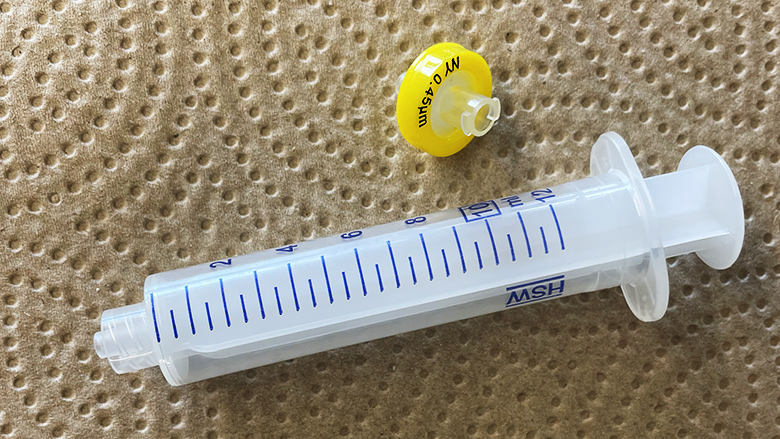
XRF (X-ray fluorescence) sample cup and syringe. Image courtesy of WACKER.
How Better Data Supports QC and R&D
Quality control environments need methods that deliver timely, repeatable results with limited operator variability. A method that requires substantial sample preparation, long analysis time or a specialized operator can work in a research setting, but QC teams need a workflow that fits routine decision-making. XRF-based silicone extractables testing can support that need by producing consistent results through equipment silicone coating facilities already use for coat weight analysis.
In production, the value comes from faster feedback and a clearer connection between data and process performance. If extractables rise after a line adjustment or material change, the team can evaluate the shift with more confidence. If extractables decrease after a cure optimization, the team can document the improvement with higher-resolution data. That feedback loop supports disciplined process control because production and QC teams can evaluate changes based on measurable extractables performance rather than indirect indicators alone.
R&D teams gain value from stronger resolution. During development work, small differences between formulations, cure profiles, or coating designs can influence the final performance of a release system. A method with better accuracy allows researchers to compare those variables more effectively and use data to guide development decisions. Instead of treating extractables as a broad pass-fail characteristic, R&D teams can use the measurement as a refined tool for studying coating behavior and selecting the most promising technical path.
The same advantage applies when technical teams support customers. If a product does not perform as expected, the issue may involve coating chemistry, cure, release force, substrate properties, adhesive interaction, storage conditions, or converting variables. Extractables data will not answer every question on its own, but stronger analytical insight can narrow the field of likely causes. A reliable XRF-based method gives technical teams a practical way to evaluate whether extractable silicone contributes to the issue and whether the coating process operates within the expected performance window.
Using Analytics to Improve Troubleshooting
Troubleshooting adhesive and release-coating performance often requires teams to evaluate several variables at once. A converter may report changes in release behavior, adhesive transfer, aging performance, odor, tack, or cohesion. Those observations can point to several possible causes, and the wrong analytical starting point can send the investigation in an inefficient direction. When extractables data lacks precision, teams may continue adjusting the coating process, changing materials or repeating tests without a clear path toward root cause identification.
Advanced analytics help technical teams move from broad investigation to targeted problem-solving. In silicone release coatings, a more accurate extractables method can help determine whether the coating process itself contributes to the reported performance issue. If extractables remain within a consistent and expected range, the team can look more closely at other variables in the adhesive system. If extractables shift, the team can focus on cure, coating conditions, raw material consistency, or process control.
Technical judgment still guides interpretation because adhesive and release systems involve complex interactions across coating chemistry, substrate behavior, adhesive formulation, converting conditions, and end-use requirements. Stronger extractables data give technical teams a better foundation for that interpretation. Such data reduce unnecessary trial-and-error testing and help teams prioritize the variables most likely to influence performance. In customer collaboration, that can shorten the troubleshooting cycle and support a more productive technical discussion.
The value also extends to internal communication between QC, R&D, operations, and technical service teams. When all groups trust the measurement, they can use the same data set to evaluate performance. QC can identify deviations more confidently, operations can assess process changes, R&D can compare formulation variables, and technical service can support customers with data that connect to real production conditions. That shared analytical foundation improves the quality of technical decision-making across the organization.
Safety and Sustainability Advantages
Testing methods influence lab safety, waste generation, and resource efficiency. Some extractables workflows require harsher solvents, hazardous reagents, flammable gases, complex sample preparation, or additional instrumentation. Each added step can increase handling requirements, operator exposure, waste streams, and operational complexity. An optimized XRF-based approach can reduce some of those burdens by using existing instrumentation and avoiding more elaborate analytical workflows for routine extractables testing.
The sustainability benefit comes partly from method efficiency. When a facility can obtain more accurate results with equipment already present in the lab, it avoids unnecessary instrumentation and reduces the operational footprint associated with more complex methods. Improved accuracy can also reduce repeat testing because teams can act with greater confidence after the first measurement. Over time, fewer repeats, fewer ambiguous results, and more targeted process adjustments can help reduce waste in the lab and on the production line.
This method can also support sustainability through better product quality. Coating operations create waste when production teams discover performance issues too late, repeat runs unnecessarily, or make broad process changes without a clear analytical basis. Stronger extractables data helps teams identify process drift earlier and evaluate whether corrective actions produce the intended result. In that sense, analytical accuracy contributes directly to resource efficiency because better data can reduce avoidable rework and material loss.
A Practical Step Forward for Release Coating Analytics
Silicone extractables testing has reached a practical inflection point for release coating manufacturers. The industry has long had accessible methods and highly sophisticated methods, although those options often force trade-offs between ease of use, accuracy, cost, and workflow complexity. An optimized XRF-based method offers a more balanced approach by applying familiar instrumentation to a more direct and higher-resolution extractables measurement.
For QC teams, the method can provide faster and more reproducible results with reduced operator variability. For R&D teams, it can deliver better resolution for formulation and process development. For operations, it can support process optimization by connecting coating adjustments to measurable extractables performance. For technical service teams, it can strengthen customer troubleshooting by helping identify whether extractable silicone contributes to a reported performance issue.
The broader significance lies in how the method changes the role of extractables data. Rather than serving only as a periodic quality check or a troubleshooting tool after a problem appears, extractables measurement can become a more useful part of process understanding. When teams can measure with greater confidence, they can make better decisions about cure, coating conditions, formulation variables, and customer support. That improves the technical foundation beneath release liner performance and the pressure-sensitive adhesive systems that depend on it.
As applications in medical, food contact, cosmetics, and other demanding markets continue to require tighter control, manufacturers need analytical methods that match the pace and precision of production. XRF-based silicone extractables testing gives the industry a practical way to increase confidence without adding unnecessary complexity. It builds on equipment many facilities already know, improves the quality of the measurement, and gives technical teams a clearer view of the coating variables that influence performance.
To consult with one of WACKER’s technical experts, or to learn more about WACKER’s XRF-based method, please reach out to Technical Chemist Justin Horst at justin.horst@wacker.com. Learn more about WACKER at wacker.com.
References
1. U.S. Environmental Protection Agency, “SW-846 Test Method 6010D: Inductively Coupled Plasma-Optical Emission Spectrometry (ICP-OES),” July 2018.
2. ASTM International, “ASTM B568-98(2021): Standard Test Method for Measurement of Coating Thickness by X-Ray Spectrometry,” 2021.
Looking for a reprint of this article?
From high-res PDFs to custom plaques, order your copy today!