Microencapsulation as a Formulation Tool: Core-Shell Design, Physical Form and Triggered Release
A technical overview of the variables that define microencapsulated systems and their relevance to adhesives, sealants and coatings formulation

Need to Know
- Core-shell microcapsules protect active ingredients from their surrounding environment.
- Coacervation forms protective membranes around encapsulated materials.
- Particle size and physical form influence dosing, handling, and formulation behavior.
- Controlled release depends on shell properties, activation mechanisms, and processing conditions.
Introduction
Microencapsulation is a formulation technology in which small quantities of a liquid or solid substance are enclosed within a protective membrane. In the core-shell systems considered here, the membrane creates a physical separation between the encapsulated material and the environment that surrounds it. This changes not only how the active ingredient is protected, but also how it can be handled and when it can become available within a formulation.1
For formulators working with adhesives, sealants, coatings, and other complex materials, this distinction is relevant because the decision to investigate microencapsulation begins before any application-specific integration is considered. The first questions concern the active ingredient itself, the physical form of the microcapsule, particle size, concentration, the behavior of the shell and the intended release mechanism. These variables define the technical characteristics of the microencapsulated system and determine what must subsequently be evaluated in the final matrix.1, 2
Microencapsulation should therefore not be viewed as a universal recipe for adding functionality to a formulation. It is better understood as a platform for controlling the relationship between an ingredient and its surroundings. The following sections examine that platform at a fundamental level, focusing on core-shell structure, coacervation, aqueous slurry and dry formats, particle size, and triggered release.
The Core-Shell Structure
A core-shell microcapsule consists of two main elements: a core containing the material to be encapsulated and an external shell that surrounds it. In the IPS systems described in the cited technical documentation, gelatin is used as the wall material for both slurry and dry microcapsules.3, 4
The shell introduces a physical barrier between the core and the external environment. IPS describes this barrier as a means of protecting sensitive raw materials from factors such as oxidation, moisture, light and heat, while also reducing direct interactions between ingredients and limiting uncontrolled dispersion of volatile or odorous substances.1 From a formulation perspective, the important point is the separation itself: the active ingredient is no longer exposed to the surrounding system in the same way as its non-encapsulated form.
This does not mean that encapsulation automatically guarantees compatibility or stability in every formulation. The final behavior depends on the active ingredient, the microcapsule characteristics, the surrounding matrix, and the process conditions.2
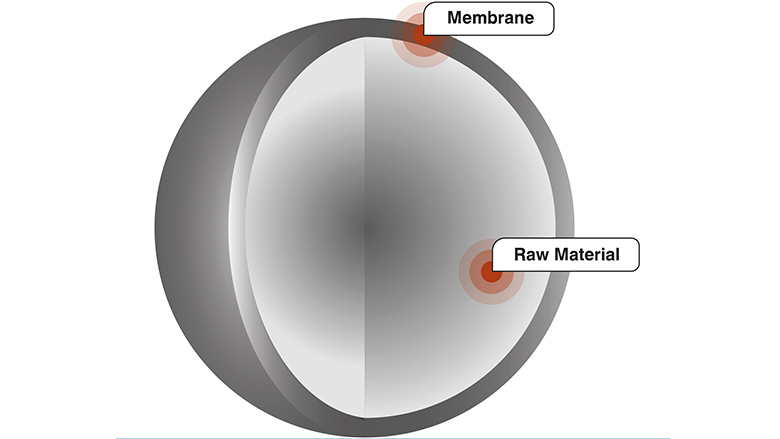
A core-shell microcapsule consists of two main elements: a core containing the material to be encapsulated and an external shell that surrounds it. Image courtesy of IPS.
Coacervation: Forming the Membrane
The process used by IPS for lipophilic substances is coacervation. In this process, the substance to be encapsulated is dispersed in an aqueous solution containing gelatin. By modifying process conditions such as pH, temperature and concentration, the gelatin coacervates and progressively deposits around droplets of the active substance, forming a thin membrane and creating the core-shell structure.3
This stage determines the architecture of the microcapsule, but not necessarily its final physical form. After the shell has been formed, the microcapsules can remain dispersed in an aqueous phase or undergo a subsequent drying stage. The distinction between slurry and dry microcapsules therefore concerns the form in which the core-shell particles are supplied and handled, not a different fundamental encapsulation principle.3, 4
That difference becomes important in formulation work because physical form affects dosing, handling and the type of process in which the material can be evaluated. A suspension and a powder may contain microcapsules based on the same core-shell principle, yet they present very different practical conditions to the formulator.
Slurry and Dry Microcapsules: The Role of Physical Form
Microcapsules in slurry are dispersed in water at a concentration that can be adjusted according to the intended application. IPS reports a typical particle-size range of approximately 20 to 500 micrometers for this format. The defining characteristic is the continuous aqueous phase in which the microcapsules are suspended.3
Dry microcapsules originate from the same coacervation route but undergo a controlled drying stage followed by sieving. Removal of the aqueous phase converts the suspension into a powder and allows defined particle-size fractions to be selected. IPS reports a particle-size range of approximately 50 to 1,500 micrometers for its dry microcapsules, with an average active content of 80 to 85% by weight and residual moisture below 10%.4
These figures are specific to the systems described in the IPS technical documentation, but they illustrate a broader formulation principle: physical form is a functional variable. A slurry introduces an aqueous suspension, while a dry microcapsule system introduces a particulate powder. The choice between the two must therefore be considered in relation to the final formulation and process rather than as a simple preference between two equivalent formats.3, 4
The dry format can also change the handling of certain liquid or oily substances by converting them into a solid, weighable form. Conversely, the slurry format retains the microcapsules in an aqueous medium. In either case, the form selected affects how the material is dosed, dispersed, and evaluated during development.1, 3, 4

Microcapsules in aqueous slurry. Image courtesy of IPS.

Dry microcapsules. Image courtesy of IPS.
Particle Size and Concentration Are Part of the Formulation
Microcapsules are particulate materials, so their dimensions matter. The IPS technical documentation reports different size ranges for slurry and dry forms and notes that the actual size depends on the encapsulated raw material and the characteristics required for the final use.3, 4
The industrial microencapsulation FAQ further clarifies that a batch does not consist of particles of one identical size. Instead, the microcapsules fall within a particle-size distribution, and in some cases this distribution can be adjusted within technical limits.2 This is important because the behavior of a particulate system cannot be evaluated on chemistry alone.
Concentration is equally relevant. At higher concentrations, microcapsules may influence rheological or optical parameters such as viscosity, color or appearance.
For a formulator, this creates a useful distinction between what the microcapsule is designed to do and how the formulation behaves when the microcapsule is present.
From Protection to Triggered Release
The protective function of the shell is only one aspect of microencapsulation. Another is the possibility of controlling the conditions under which the encapsulated material becomes available to respond to specific physical or chemical stimuli: changes in pH pressure, friction, or mechanical rupture of the shell.1, 2
The expression controlled release should therefore be understood as a design concept rather than as one standard release profile. In a mechanically activated system, the relevant event may be pressure or friction.
Processing itself also becomes part of this evaluation. The FAQ notes that microcapsules can rupture during mixing, pumping, or other mechanical operations if the stresses exceed the mechanical strength of the shell.2 A trigger that is useful during final use may be undesirable if it occurs prematurely during manufacturing. This is why the release concept cannot be separated from the process conditions to which the capsules will be exposed.
Why These Fundamentals Matter to Formulators
For adhesives, sealants, and coatings formulators, the relevance of microencapsulation lies first in these fundamental formulation questions rather than in a predefined application recipe. A microencapsulated system introduces an active ingredient in a protected form, with a defined physical state and a release mechanism.
This makes microencapsulation a technology that can be evaluated when a development project requires greater control over how an ingredient is isolated, handled, or released. It does not, however, establish that a given microcapsule will be compatible with a particular adhesive, sealant, or coating matrix. The suitability of the system depends on the specific formulation, processing conditions, and performance requirements, and must be established experimentally.2
This distinction is especially important in sectors where formulations can vary widely in chemistry, and manufacturing conditions. The microencapsulation can define the characteristics of the capsule, but the formulator retains responsibility for understanding the target matrix and for verifying whether those characteristics are compatible with the intended process. The relevant question is therefore not simply whether microcapsules can be used in adhesives or sealants, but which capsule variables would need to be investigated for a specific formulation challenge.
Seen in this way, microencapsulation is relevant to the formulation theme without requiring assumptions about a specific adhesive system. It provides a structured set of variables to evaluate: what is being encapsulated, which physical format is appropriate for investigation, what particle-size range is acceptable, which release mechanism is desired, and what compatibility tests are needed before moving beyond feasibility.2
A Feasibility-Led Development Approach
Because these variables interact, microencapsulation development is necessarily application specific. IPS describes a structured development sequence that begins with analysis of the raw material and definition of the microencapsulation strategy.
The FAQ similarly describes preliminary feasibility assessment as a way to identify technical challenges before committing to a full project. Samples and pilot batches can then be used for application trials, process validation, and performance testing executed by formulators.2
This sequence is relevant to formulators because it separates two questions that are often confused. The first is whether an ingredient can be microencapsulated with the required characteristics. The second is whether that microencapsulated material performs appropriately in the final formulation and manufacturing process. A technically sound development program must answer both questions.
For adhesives, sealants, and coatings, this is the appropriate level to approach the technology: begin with the microencapsulation variables, then establish compatibility through formulation-specific testing. The technology provides the design framework; the final matrix determines whether that framework can be translated into a viable application.
Conclusion
Microencapsulation changes the physical relationship between an ingredient and its surrounding formulation. In the core-shell systems described here, a gelatin membrane is formed around a lipophilic active by coacervation, after which the microcapsules can remain in aqueous suspension or be converted into a dry powder.3, 4
The resulting material is defined by more than the identity of the encapsulated substance. Particle size, particle-size distribution, concentration, physical form, shell characteristics, and release mechanism all contribute to how the system behaves. These variables also influence what must be assessed when the microcapsules are introduced into a formulation.1, 2
For formulators in adhesives, sealants, and coatings, the value of understanding microencapsulation lies in recognizing these variables before making application-specific assumptions. The technology can provide physical separation, protection, and controlled availability of an ingredient, but its suitability must be demonstrated within the actual matrix and process.1, 2
Microencapsulation is therefore best treated as a formulation tool to be investigated, not as a ready-made application. Its potential comes from the possibility of designing the capsule around a defined objective, while its practical value depends on experimental validation in the system for which it is being considered.
Learn more about I.P.S. International Products & Services at https://ips-industrial.it/en.
References
1. I.P.S. International Products & Services S.r.l. Microencapsulation Technology. https://ips-industrial.it/en/microencapsulation-technology/
2. I.P.S. International Products & Services S.r.l. Industrial Microencapsulation FAQ. https://ips-industrial.it/en/industrial-microencapsulation-faq/
3. I.P.S. International Products & Services S.r.l. Microcapsules in Slurry. https://ips-industrial.it/en/microencapsulated-products/microcapsules-in-slurry/
4. I.P.S. International Products & Services S.r.l. Dry Microcapsules. https://ips-industrial.it/en/microencapsulated-products/dry-microcapsules/
Looking for a reprint of this article?
From high-res PDFs to custom plaques, order your copy today!