Lighter, Faster, Better: The Impact of Adhesives on Train Design and Performance
aapsky / iStock / Getty Images Plus via Getty Images
In the rail industry, the quest for efficiency, speed, and sustainability drives innovation. Lightweighting, the practice of reducing the weight of train components and structures, has emerged as a key strategy to meet these goals. While lightweighting is common in various transport industries, such as automotive and aerospace, its application in rail requires unique considerations. Unlike cars and lorries, where individual components can be easily replaced or modified, trains are complex systems that operate over longer distances and under more varied conditions. The materials and design techniques used in rail lightweighting must withstand the rigorous demands of continuous operation and changing climates while maintaining structural integrity and safety. By focusing on these specialized materials and techniques, train manufacturers can offer more efficient and environmentally friendly solutions tailored to the specific needs of rail transport. This approach enhances performance, reduces energy consumption, and opens new possibilities for train design and aesthetics.
Benefits of Lightweighting
The benefits of reduced weight in trains are significant. Improved energy efficiency is one of the most compelling advantages, as lighter trains require less energy to accelerate and maintain speed. Greater efficiency leads directly to substantial energy savings, reducing operational costs and lowering carbon emissions. For example, a 10% reduction in weight can boost energy efficiency by up to 10%. Enhanced speed and performance are other benefits, with lighter trains able to achieve higher speeds more quickly, improving overall performance. Passengers benefit, too, as journeys are faster and service schedules become more efficient. Reduced weight also means less stress on tracks and infrastructure, reducing wear and tear, which leads to lower maintenance costs and a longer lifespan for both trains and tracks. Additionally, by reducing the weight of the train itself, more capacity is available for passengers and cargo, leading to increased revenue opportunities for train operators.
The Role of Adhesives in Lightweighting
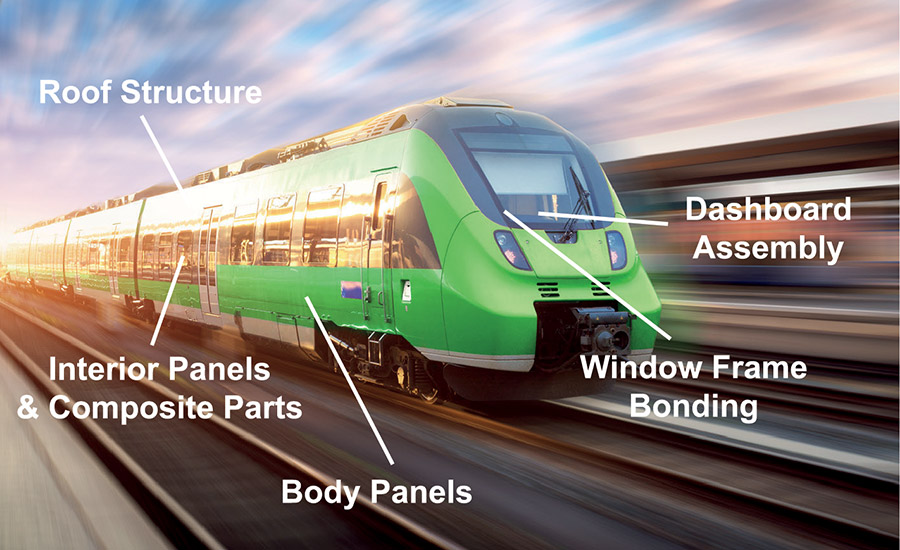
Adhesives play a crucial role in lightweighting trains, offering innovative solutions that traditional mechanical fasteners cannot. But where exactly within the structure of the train are adhesives being used? They are commonly utilized to attach external parts, bond structural and decorative panels, secure interior components such as seats and flooring, and even assemble electrical components. Adhesives are also applied in critical areas such as sandwich panels for interiors, bonding composite and plastic parts, and in the roof and floor structures. Dashboards and window glazing are other areas where specific adhesives are essential.
The best adhesive for each application depends on specific requirements. For instance, a single-component, moisture curing adhesive like polyurethane (PU) or silane modified polymer (SMP) may be sufficient and cost-effective when low strength and high flexibility are needed. For bonding windows, a direct glazing adhesive, typically a single-component PU, is often selected. When it comes to structural adhesives, options include two-component PU, epoxy, and methyl methacrylate adhesives (MMAs). Epoxy offers higher strength and environmental resistance but comes at a higher cost and has a slower reaction time. MMAs, on the other hand, provide a good balance between strength and flexibility, offering a middle ground in terms of pricing and performance. PUs are generally cheaper but have lower strength, requiring trained workers due to REACH regulations and have slower curing times. Additionally, adhesive tapes are also utilized in certain areas of train construction.
Among the different types of adhesives, MMAs are often considered the best for train applications due to their exceptional bonding strength, durability, and resistance to environmental factors. Manufacturers that specialize in MMAs offer a range of solutions specifically designed for the rail and transportation industries. These adhesives are tailored to meet the unique demands of train construction, ensuring high performance in both structural and exterior applications. MMAs are especially valued for their ability to cure at low temperatures, making them ideal for the manufacturing environment, and for their UV stability in exterior applications. By working with specialized adhesive providers, train manufacturers can ensure they are using the most suitable products to meet industry regulations and achieve optimal performance.
When considering adhesives for train applications, it is essential to adhere to relevant industry standards and specifications. The most important of these is railway standard EN 45545 for fire safety requirements in railway vehicles. Compliance ensures that the adhesives not only perform effectively, but also meet safety and regulatory requirements.
Aesthetics and Comfort
Adhesives in train construction also open exciting possibilities for design and aesthetics. Adhesives enable seamless bonding of panels and components, creating smooth, unbroken surfaces that enhance the visual appeal of trains. This allows for modern and sleek designs that are both functional and attractive. The flexibility of adhesives enables designers to experiment with innovative shapes and configurations, leading to unique train designs that stand out in the market and offer competitive advantages. Additionally, adhesives ensure the construction of lightweight interior components, enhancing passenger comfort without sacrificing durability. From seating and paneling to dashboard assembly, adhesives offer opportunities for creative designs that enhance the passenger experience.
Energy Savings and Sustainability
The benefits of lightweighting extend beyond aesthetics and performance, significantly impacting efficiency and energy savings. Lighter trains consume less energy, leading to lower costs and reduced greenhouse gas emissions. This aligns with global efforts to combat climate change and promote sustainable transportation. Reduced weight enhances acceleration and braking performance, leading to more efficient operation, smoother rides, and improved passenger safety. With less weight, trains can travel longer distances on the same amount of energy, increasing operational range and flexibility, and allowing train operators to expand services without additional energy costs. As the industry continues to embrace lightweighting, new materials and adhesive technologies will drive further innovation, leading to even more efficient trains that meet the demands of modern transportation.
Conclusion
In conclusion, lightweighting in rail, facilitated by the strategic use of adhesives, offers numerous benefits that align with the industry's goals for efficiency, sustainability, and innovation. By reducing weight, improving performance, and enhancing design, adhesives are key to the next generation of trains. As the rail industry looks to the future, lightweighting will play a crucial role in shaping trains that are not only faster and more efficient but also more environmentally friendly and aesthetically pleasing. Embracing this approach will position train companies to meet the challenges of tomorrow's transportation landscape.
Learn more about IPS Adhesives at https://ipsadhesives.com.
Looking for a reprint of this article?
From high-res PDFs to custom plaques, order your copy today!