Product Focus: Electronics
Protecting Electronics with Advanced Technologies
Need to Know
- Demand for electronics adhesives continues to grow, driven in part by the expansion of data centers and related equipment.
- This polyurethane potting compound provides electrical insulation, thermal conductivity, and protection against vibration, moisture, and corrosion.
- A new curing agent offers a gel time of approximately 8 minutes at 25 °C for fast-setting epoxy formulations.
- An adhesive offers cure at temperatures as low as 45 °C, enabling the bonding of heat-sensitive components and materials.
The market for adhesives used in electronics applications remains one of the fastest-growing in the industry, thanks in part to the growth of data centers and the equipment used in those centers. As companies strive to meet demand, adhesives and sealants for electronics applications are expected to perform many functions, including insulating against electrical failure, managing heat, absorbing vibration, and protecting sensitive components against moisture and corrosion. In addition, these products must be compatible with new manufacturing processes for dispensing and curing. We are featuring products that help end users and formulators meet these requirements. They include a potting compound, a low-temperature adhesive, and a hardener for formulators developing epoxy systems.
WEVO-CHEMIE: Potting Compound
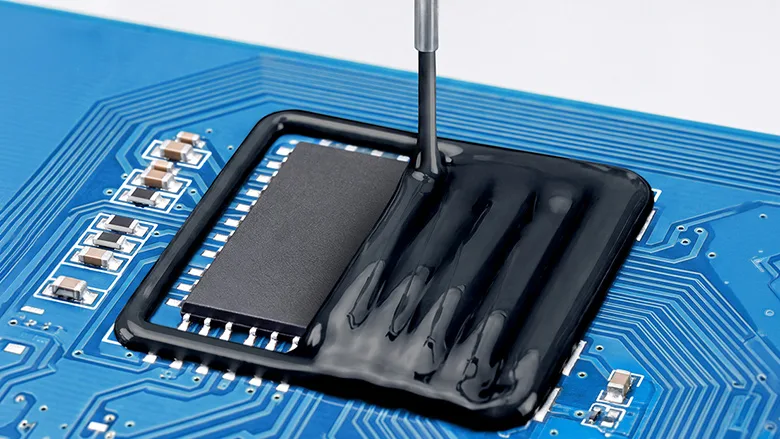
WEVOPUR 60210 FL T is a polyurethane system specially developed for highly complex multi-layer printed circuit boards (PCBs) used in modern battery management systems. It combines electrical insulation, thermal conductivity and precisely adjusted mechanical properties. With its optimized rheology, it enables automated processing using the dam-and-fill method.
With a Shore hardness of D 40 to 50, the product absorbs shocks and vibrations as well as stresses caused by fluctuating temperatures. Its thermal conductivity of 0.8 W/m·K enables heat to be distributed within the potted assembly and helps reduce temperature differences between the PCB components. With this polyurethane system, the risk of stress cracks and solder joint detachment is reduced. Adhesion properties also ensure a durable bond between the potting compound and the substrate and help prevent delamination.
A dielectric strength of more than 20 kV/mm supports electrically insulated battery management systems, and its formulation is designed to prevent electrochemical corrosion and protect the components from moisture.
With the “dam-and-fill” method, the flow behavior and thixotropy are specifically adjusted so that the barrier retains its shape while the filler completely wets the area to be protected without forming any air pockets.
Learn more at wevo-chemie.
Credit: Sunshine Seeds / iStock via Getty Images Plus
PFLAUMER BROTHERS: Curing Agent
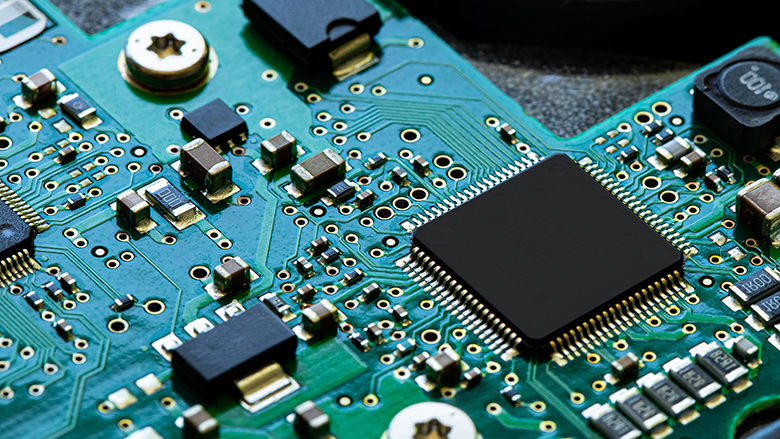
TERAMINE® 914SF from Pflaumer Brothers is modified aliphatic amine curing agent designed for use with bisphenol A and bisphenol F epoxy resins. Engineered for epoxy systems requiring rapid cure speed, excellent adhesion, and strong mechanical properties, it is suitable for applications where fast processing and dependable performance are critical. Designed to cure at ambient temperatures and offering a gel time of approximately 8 minutes at 25 °C, it is well-suited for epoxy systems where speed, consistency, and reliable handling are important.
TERAMINE 914SF is intended for use at a 2:1 ratio with bisphenol A and bisphenol F epoxy resins. Applications include electronics, potting, and encapsulation. It can also be used in general-purpose adhesive in structural applications.
Additional features include excellent adhesion, rapid hardness development, low viscosity, low color, and strong mechanical performance. Formulated without nonyl phenol or benzyl alcohol, it provides a practical and efficient option for fast-setting epoxy formulation development.
Learn more at pflaumer.com.
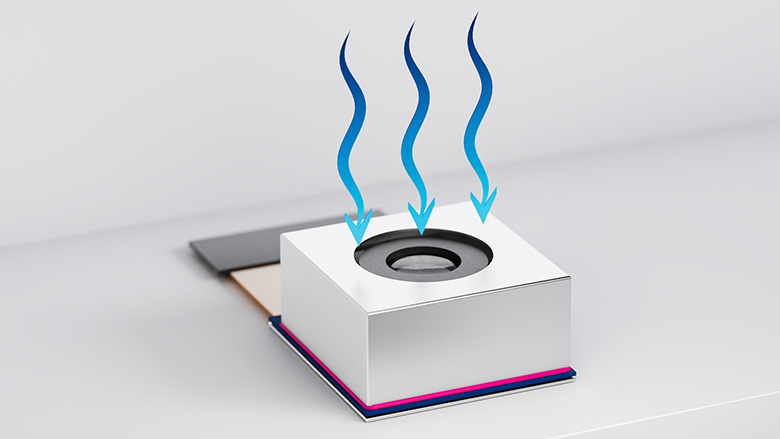
Image courtesy of DELO
DELO: Super-Low-Temperature Curing Adhesives
DELO has introduced super-low-temperature (SLT) curing adhesives for consumer electronics assembly that cure at temperatures as low as 45 °C. Part of the company's DUALBOND LT family, the adhesives cure in as little as 10 minutes at 60 °C or one hour at 45 °C. The SLT adhesives combine light fixation — a brief UV or visible light exposure that locks components in place within seconds — with a subsequent low-temperature curing step that delivers full mechanical strength and long-term reliability.
Curing at 60 °C for 10 minutes can allow manufacturers to use inline heat tunnels instead of batch ovens, and simulations showed reduced component deformation when curing at 45 °C compared with higher temperatures. Additionally, curing temperatures can enable the bonding of heat-sensitive components and materials. For example, small integrated batteries can remain in an assembly during bonding, while cellulose-based substrates can be used in applications where higher curing temperatures previously presented challenges.
Learn more at delo-adhesives.com.
Looking for a reprint of this article?
From high-res PDFs to custom plaques, order your copy today!