Electric Infrared vs. Gas Convection Ovens for Industrial Applications
Understand how heating methods, product geometry, energy costs, and facility requirements influence industrial oven performance and selection.

Need to Know
- Heating Technology: Infrared targets surfaces, while gas convection provides more uniform heating around complex shapes.
- Energy Efficiency: Infrared can reduce energy use, while gas may offer lower operating costs.
- Product Geometry: Infrared favors flat materials; gas convection suits complex components.
- Oven Selection: Evaluate utility costs, facility requirements, maintenance, and material compatibility.
Conveyor tunnel ovens are used across a wide range of industrial manufacturing processes, including curing coatings, drying adhesives, fusing substrates, and processing electronics. Thermal performance directly affects product quality, throughput, and operating cost. The choice between electric infrared (IR) and gas convection oven technology is consequential, and neither is universally superior. The correct selection depends on process requirements, facility conditions, and long-term operational goals.
How Each Technology Works
Gas-fired convection ovens use burners to heat air within a chamber. Forced-air circulation transfers the heated air to items moving along the conveyor belt, producing a stable, uniform temperature throughout the chamber. Direct-fired designs expose the oven air to combustion gases. Indirect-fired designs isolate combustion gases from the oven air through a heat exchanger.
An electric infrared tunnel oven transfers energy to the product surface through electromagnetic radiation rather than through heated air. The product surface absorbs the incoming radiation and converts it to heat. The effectiveness of this energy transfer depends on the match between the emitter's spectral output and the absorptive characteristics of the material being processed, which vary with surface finish, coating type, pigment, and substrate. Emitter panels, reflectors, and shielding focus radiant output at the point of application. This surface-targeted delivery is the defining characteristic of IR technology and the basis for most of its process and operational advantages.
Advantages of Gas-Fired Convection Ovens
Gas-fired convection technology maintains a stable, uniform chamber temperature across the oven volume. Forced-air circulation distributes heat around product surfaces, including recesses, irregular geometries, and features not directly exposed to a radiant source, making gas convection well suited to three-dimensional parts with complex geometry. Both IR and convection systems transfer heat to the product interior primarily through conduction from the heated surface. The practical advantage of convection for geometrically complex products is more uniform surface exposure across all faces of the part, regardless of orientation or shielding.
Where natural gas infrastructure is in place and local gas rates are lower than electricity rates, gas ovens can offer a lower cost-per-BTU. In high-volume, continuous operations at high utilization, this energy cost differential may offset higher capital and installation costs over time.
These advantages are utility-rate dependent and not universal. Where electricity is competitively priced, or where carbon-related pricing applies to gas, the cost differential narrows or reverses. The higher capital cost of gas oven construction, combustion safety systems, air handling equipment, and the floor space consumed by longer oven chambers must be weighed against potential per-BTU fuel savings.
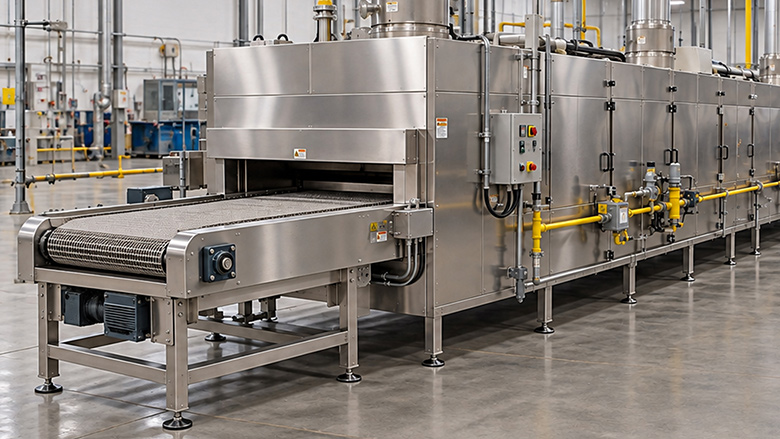
Gas convection tunnel oven. Image courtesy of Vastex Industrial.
Advantages of Electric Infrared Tunnel Ovens
Because IR energy is absorbed directly at the product surface, less energy is expended heating the surrounding air volume than in a convection system. This can reduce total energy consumption relative to gas-fired convection for applications where surface heating is the primary process requirement. The extent of this advantage is application-specific and depends on product geometry, required process temperature, conveyor speed, and oven utilization. Comparative energy performance should be evaluated using application-specific test data, accounting for electricity consumption in kWh and gas consumption in BTU or therms.
Rapid surface temperature rise reduces dwell time for surface heating applications, allowing shorter oven chambers that reduce capital cost and facility footprint. Processes governed by solvent evaporation, chemical crosslinking, or heat conduction into the product interior require dwell times set by those process requirements, and oven length must reflect them accordingly.
Electric IR ovens do not require fuel supply lines, gas trains, combustion safety controls, or combustion exhaust systems, reducing mechanical complexity and eliminating fuel-handling hazards. IR ovens may still incorporate insulation, particularly at elevated operating temperatures, to reduce thermal losses and limit exterior surface temperatures. The elimination of combustion systems does, however, remove the need for the thick refractory insulation required in direct-fired gas designs, contributing to a more compact overall footprint and fewer systems to maintain.
Direct-fired gas ovens must exhaust both process emissions and combustion byproducts. Electric IR ovens do not generate combustion exhaust, eliminating that exhaust system requirement. Both technologies require appropriate ventilation for process-generated emissions, including vapors and VOCs released by coatings, inks, adhesives, and substrates during heating. Applicable ventilation standards, including NFPA 86, apply to both technologies based on process hazards and should be evaluated for each application.
Multiple independently controlled heating zones allow precise thermal profiling along the conveyor length. This is valuable for heat-sensitive substrates where overexposure causes damage and for processes requiring distinct thermal stages within a single pass. Zone control produces consistent, repeatable results across production runs.
Some electric IR tunnel oven designs allow production capacity to be expanded incrementally by adding heating chambers and lengthening the conveyor belt, without replacing the base unit. Some configurations are portable or mobile. Modular and expandable designs are also available in gas-fired equipment; expandability is a product-design characteristic that should be confirmed with the specific equipment supplier under evaluation. Without combustion components, burners, or gas trains, routine maintenance on electric IR ovens is straightforward.
Product Geometry and Radiant Exposure
Infrared radiation travels in straight lines from the emitter to the product surface. Surfaces with direct exposure to the emitters receive full radiant flux; recesses, undercuts, vertically oriented features, and components that shadow adjacent parts receive reduced or no direct radiation. Heat transfer to shielded surfaces then depends on conduction from adjacent heated areas or on any convective contribution within the oven enclosure. Gas-fired convection systems distribute heat more uniformly around irregular geometries through forced-air circulation. For applications processing relatively flat or consistently oriented products, such as coated sheet stock, film, nonwovens, printed substrates, and similar web or panel materials, this limitation is generally not a significant factor.
Material Absorption and Process Validation
The effectiveness of infrared heating depends on the match between emitter spectral output and the absorptive properties of the product surface. Absorption varies with coating type, pigment, surface finish, and substrate, and cannot be assumed without verification. Testing on representative production samples is the most reliable means of confirming that a given oven configuration meets process requirements before equipment is specified or installed. This applies to both drying and curing applications: surface temperature may rise rapidly under infrared, but solvent removal, chemical crosslinking, and heat penetration into the product are governed by process requirements that must be validated independently of surface temperature measurements.
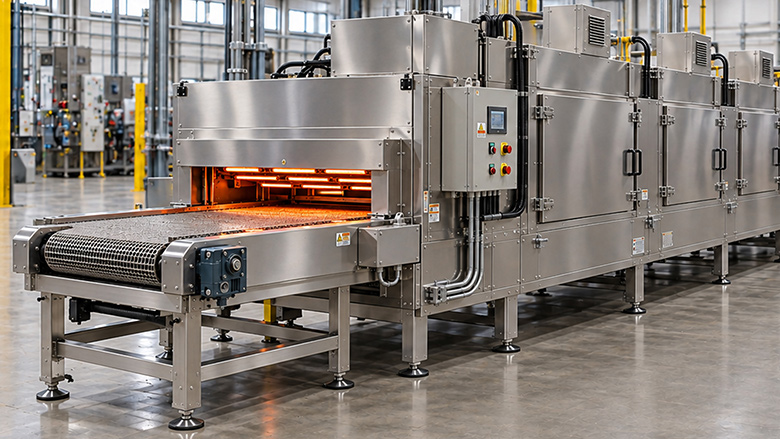
Electric infrared tunnel oven. Image courtesy of Vastex Industrial.
Industrial Applications
Both technologies serve a broad range of industrial applications, including:
- Adhesive lamination
- Aerospace and automotive manufacturing
- Annealing and thermoforming of plastic film
- Battery electrode processing
- Coatings, powder coating, and melt powder coating
- Composites and fiberglass
- Curing of aircraft control panels and printed circuit boards
- Curing of printing on glass, metal, plastics, rubber, and textiles
- Electronics assembly and medical device manufacturing
- Flexible packaging, foil, and film
- Flooring including vinyl sheet and tile
- Graphic arts, inkjet printing, and flexographic and gravure printing
- Industrial fabrics, narrow fabrics, nonwovens, and coated fabrics
- Paper and pulp; plastics, rubber, vinyl, and plastisol
- Pre-heat, fusing, embossing, and foam-expansion operations
- Wire and cable, tubing, and shrink coating
Oven selection within any application should be driven by process-specific requirements. Applications involving heat-sensitive materials, flat or consistently oriented product geometries, or surface-targeted heat delivery favor IR. Applications involving three-dimensional parts with recesses or shielded surfaces, or processes requiring sustained uniform bulk heating, favor gas convection.
Key Decision Factors
Process requirements: Surface treatment, short dwell times, or multi-stage thermal profiles favor IR. Processes requiring uniform heating of complex or irregular geometries, or sustained bulk heating where conduction to the product interior is the rate-limiting step, favor gas-fired convection.
Product geometry: Flat or consistently oriented products are well suited to IR. Three-dimensional parts with recesses, undercuts, or surfaces that cannot be oriented toward the emitters favor gas convection.
Material and absorption characteristics: IR effectiveness depends on the match between emitter spectral output and the absorptive properties of the product surface. Material testing is necessary to confirm adequate energy absorption before specifying IR for a new application.
Facility infrastructure: Facilities without gas supply lines incur significant installation cost to commission a gas oven. Facilities with existing gas infrastructure and limited electrical service should also account for the cost of electrical service upgrades, which can be substantial for larger IR installations requiring three-phase power.
Floor space and capital cost: IR ovens can be shorter in length where surface heating determines dwell time and eliminate combustion system components, reducing footprint and procurement cost where those conditions apply.
Utility costs: Gas-versus-electricity cost comparisons vary by region and shift over time. Financial modeling should use current and projected local rates, comparing consumption in kWh against BTU or therms.
Throughput and production volume: High-volume continuous operations may favor gas where local rates make it cost-effective. Moderate-volume, multi-product, or precision-process environments generally favor the output control and faster adjustment of IR systems.
Operator safety and regulatory compliance: Gas systems require compliance with standards governing fuel supply, burner management, combustion exhaust, and related hazards. IR systems eliminate combustion-specific hazards but introduce electrical safety requirements and require appropriate ventilation for process emissions. Applicable codes and standards should be reviewed for both technologies based on the specific process and facility.
Long-term flexibility: Where product mix, production volume, or facility layout is likely to change, modular IR system designs can allow incremental capacity expansion. This is a product-design consideration that should be confirmed with the equipment supplier for either technology under evaluation.
Conclusion
Selecting between electric infrared and gas convection ovens is a process-specific engineering decision. IR offers advantages in direct surface heating, elimination of combustion-related systems, compact footprint, fast radiant output control, and reduced mechanical complexity for applications where surface-targeted heat delivery is the primary process requirement. Gas-fired convection offers stable enveloping heat, uniform exposure around complex geometries, and potential energy cost advantages in high-volume operations where local gas rates are favorable.
Neither technology is universally superior. Specifiers should define process requirements precisely, characterize product geometry and material absorption properties, assess facility infrastructure and utility costs, and validate performance through representative product testing before committing to either platform.
Vastex Industrial’s patented innovations include the first small-product electric infrared oven, an oven air recirculation system, and a patented belt alignment/tracking device. Founded in 1960, the company built its first factory in Branchburg, New Jersey in 1973 and in 2017 completed its current manufacturing facility and world headquarters in Bethlehem, Pennsylvania. Vastex ovens now operate in over 50 countries. Learn more at vastexindustrial.com.
Looking for a reprint of this article?
From high-res PDFs to custom plaques, order your copy today!