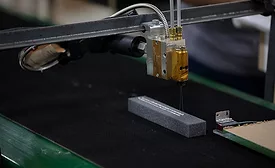
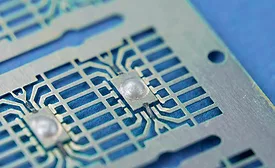
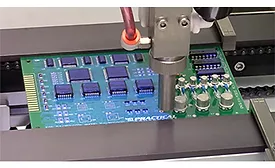
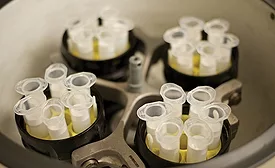
Vacuum potting is mainly aimed at electronic components with small openings and complex internal structures.
The potting of electronic components involves filling the assembly with a compound such as liquid resin (e.g., epoxy, silicone, polyurethane) to protect it from environmental or use conditions like moisture, humidity, and vibration. Any air entrapment in the potting compound can result in air bubbles that may cause performance problems in the finished component.
Chicago Glue recently helped Systematics more than double its output of face shields for healthcare workers on the front lines of the coronavirus pandemic.
When running a business, many scenarios cross your mind. You prepare and plan and adapt. Yet very few, if any, can say they were prepared for the global pandemic that has put stress on not only their company, but also its team members and its operations. As always in challenging times, good things still have the opportunity to happen.
Dow’s new environmentally responsible silicone technology reportedly promotes sustainability, health, and safety while reducing processing costs through automated spraying and fast, energy-efficient UV curing.
The new DOWSIL CC-8030 UV and moisture dual-cure conformal coating from Dow is reportedly the industry’s first solventless silicone conformal coating with an ultraviolet (UV) and moisture dual-cure system for high throughputs.
The correct adjustment of flow characteristics of sealants and thermosetting adhesives is crucial to their performance in automated, high-speed production environments.
The automated application of sealants and adhesives in settings such as automotive production requires that predictable, reproducible quantities are applied, and that they flow properly and remain in place during the final setting period.
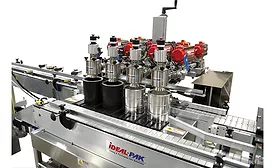
While many filling technologies exist, gravimetric or net weight fillers remain a predominant fill method in the CASE industry. These fillers utilize a scale to measure the precise amount of product dispensed to a container.
Cincinnati-based Pilot Chemical earned the Karl G. Voelkel Industry Award for wastewater improvements and accomplishments at its plant in Middletown, Ohio.
Pilot Chemical Co. recently announced that the Southwest Section of the Ohio Water Environment Association (OWEA) has honored Pilot Chemical with the Karl G. Voelkel Industry Award for outstanding environmental achievement.
Automatic labeling equipment is garnering significant traction over semi-automatic and manual systems.
Predominantly pushed by brisk expansion in the packaged food sector, labeling equipment sales will thrive at a healthy CAGR over the course of next decade.
An appliance manufacturer successfully upgraded its freezer assembly process from an outdated XY-applied hot-melt pressure-sensitive adhesive to a fully automated XYZ application.
Electrolux is a global manufacturer of appliances ranging from washers and dryers to water heaters and dishwashers.