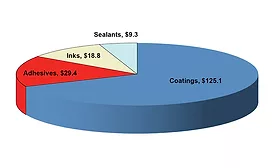
The global consumption of coatings, adhesives, sealants and inks (CASI) is being driven primarily by construction applications.
Global consumption of coatings, adhesives, sealants and inks (CASI) was 54.1 million tons in 2014, worth $182.6 billion, according to Kusumgar, Nerlfi & Growney. Volume growth is forecast at a 5% annual rate, with coatings, adhesives and sealants matching the overall growth, but inks trailing at only 2% per year.
A new manufacturing process allows touchscreens to be flexible, curved, 3-D or wearable.
Heraeus recently announced that, in collaboration with the Industrial Technology Research Institute (ITRI), it has developed an improved mass-manufacturing process for its Clevios™-based films used in touch panels and sensors for a variety of electronics devices. This process will reportedly enable companies to use Clevios-based films to produce touchscreens with greater functionality, including the ability to be flexible, curved, 3-D or wearable.
Throughout my more than two-decade tenure as an executive coach and vice president in corporate America, I have seen millions of dollars senselessly lost due to ineffective communication.
Growth in the UV-curable ink market is being spurred by increased use in food and beverage packaging.
Introduced in 1960, ultraviolet (UV) curable ink has resulted in increased automation, particularly in the manufacturing sector. Originally, water- and solvent-based inks were used for flexographic printing, textile printing, screen printing, and more.
Growth areas for flexible packaging include both food and nonfood applications.
Demand for converted flexible packaging in the U.S. is projected to increase 3.3% annually to $20.7 billion in 2019. Although advances will decelerate from the pace of the past decade, converted flexible packaging will remain a growth area in both food and nonfood applications due to the inherent cost and performance advantages of lightweight bags and pouches.
Experts believe these three technologies will have great potential in the next five years.
The Internet of Everything, cloud computing/big data and 3D printing are three of the technologies most likely to transform the world during the next five years, according to IHS Technology.
Light-curing adhesives are essential in many industries because they speed up the production process. Many applications in the optoelectronics and automotive industries, such as cameras, electronics displays, and LEDs and sensors, wouldn’t be possible without the use of these types of adhesives.
A corrugated converter cuts defects to near zero and increases output and customer satisfaction with new gluer, detection, and trim systems.
It’s tough to be perfect when producing millions of custom boxes every year—but customers expect it. If defective boxes turn up in a shipment, customers gladly return them—along with a complaint.
Scientists and engineers have long used biomimicry as a way to find solutions to today’s problems in nature. For example, studying shark skin has led to new materials that bacteria cannot attach to, birds and bats have inspired aircraft design, and investigating plant leaves has resulted in light absorption efficiency innovations in solar panels.
Hot-melt adhesives have played a key role in the packaging process for decades, but traditional technology using heated tanks is less efficient when compared to new systems available today.
 RSS