Adhesives Mag logo
search
cart
facebook twitter linkedin youtube
  • Sign In
  • Create Account
  • Sign Out
  • My Account
Adhesives Mag logo
  • NEW PRODUCTS
  • NEWS
    • Adhesives & Sealants Headlines
    • Mergers/Acquisitions
    • Market Trends
    • TOP 20
  • TOPICS
    • Finished Adhesives and Sealants
    • Pressure-Sensitive Adhesives (PSAs)
    • Coatings
    • Raw Materials and Chemicals
    • Materials Handling/Processing
    • Meter/Mix/Dispense
    • Curing
    • Testing/Quality Control
    • Packaging of Adhesives & Sealants
    • Converting/Packaging
    • Composites
    • Sustainability
  • EVENTS
    • ASI Academy
    • Events Calendar
  • COLUMNS
    • European Perspectives
    • Strategic Solutions
    • Supply Chain Strategies
    • Tape Talk
  • MULTIMEDIA
    • Videos
    • Podcasts
    • Webinars
    • eBooks
  • EXPLORE
    • Adhesives in Action
    • Blog
    • ASI Store
    • Industry Links
    • Market Research
    • Classifieds
  • DIRECTORIES
    • Buyers' Guide
    • Global Adhesives & Sealants Directory
    • Raw Materials, Chemicals, Polymers and Additives Handbook
    • Equipment Handbook
    • Distributor Directory
  • EMAGAZINE
    • EMAGAZINE
    • ARCHIVE ISSUES
    • ADVERTISE
      • Custom Content & Marketing Services
    • CONTACT
  • SIGN UP!
SustainabilityRaw Materials and Chemicals

Enabling Sustainable Solutions for Packaging Hot Melt Adhesives with Functionalized Polyolefin Elastomers

The use of low-viscosity polyolefin materials in HMA formulations can lead to increased cost savings and lowered carbon footprint.

By Santosh Bawiskar, Yue Deng, Yinzhong Guo, Ibrahim Kamara, Allan McLennaghan, Shankar CV Ram, Max Yang
graphic showing a sustainable planet

image courtesy of Dow

September 22, 2024

Hot-melt adhesives (HMA) are formulated systems with extensive use in packaged goods, particularly in the bonding of cardboard boxes. This type of system requires the application of a formulation that includes polymer, tackifier, and wax in the molten state, which, due to its low viscosity at the application temperature, spreads over the substrate and rapidly solidifies to make the bond. Polymer is critical in providing cohesive strength, thermal stability, and good performance across a wide range of temperatures. Among the polymers used in packaging HMA formulations, low-viscosity polyolefin materials commercialized by Dow as AFFINITY™ GA Polyolefin Elastomers have demonstrated superior adhesion, improved low application temperature, ease of processability, and thermal stability versus EVA based formulations. This performance translates to increased cost savings and also lowered carbon footprint for the HMA user (Figure 1).

Switching to AFFINITY GA Polyolefin Elastomers has the advantage of saving cost and CO2 emissions.
FIGURE 1 » Switching to AFFINITY GA Polyolefin Elastomers has the advantage of saving cost and CO2 emissions.

The HMA industry has been moving towards solutions that are safer, more efficient, and have a lower carbon footprint. This move results in three prominent changes in the space: substrate changes, regulatory shift towards safer materials, and the need for higher biobased content.

First, the emphasis on sustainability has driven substrates to include higher recycled content and various surface coatings for improvement in quality, functionality, and appeal in packaging. Recycled boards have reduced fiber length and increased contaminants on the surface (Figure 2). The recycled materials may also contain mineral oil aromatics. While this recycled board is suitable for some case and carton applications, the German Ordinance on Consumer Goods establishes limits on the transfer of mineral oil aromatic hydrocarbons (MOAH) from food contact materials (FCMs) made from recycled paper. It specifies that a functional barrier will be required in paper, paperboard, and cardboard for FCMs containing recycled paper, which ensures that no aromatic mineral oil hydrocarbons are transferred from the FCMs to the food. Thus, coatings are common with increased recycled content in addition to applications that require a better visual appeal. Such cardboards are usually coated with bi-axially oriented polypropylene (BOPP), or wax, or glossy oil prints that are difficult to adhere to, due to their polar nature and/or lower porosity (Figure 2).
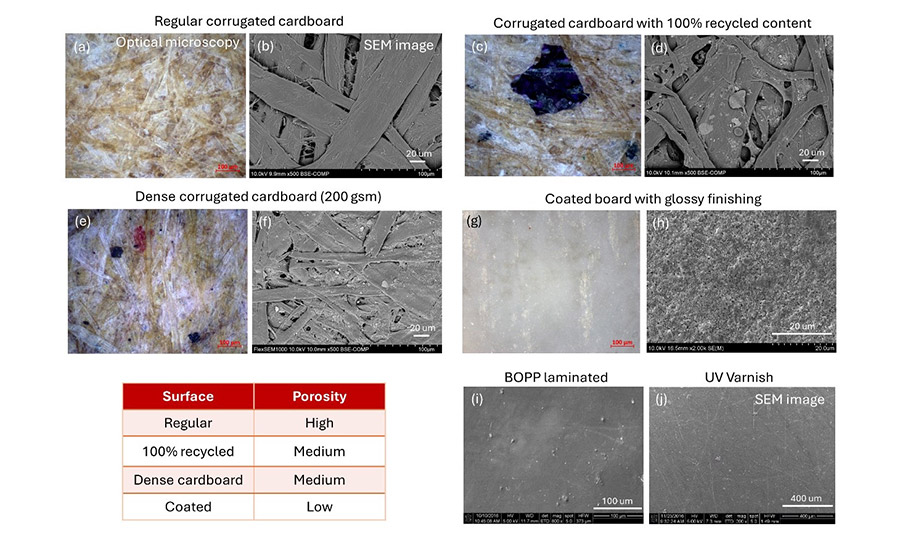
Differences in surface properties of regular and hard-to-bond cardboard substrates based on optical microscopy image (scale bar 100 μm) and scanning electron microscopy (SEM). Table compares the relative porosity of various surfaces.
FIGURE 2 » Differences in surface properties of regular and hard-to-bond cardboard substrates based on optical microscopy image (scale bar 100 μm) and scanning electron microscopy (SEM). Table compares the relative porosity of various surfaces.

To address these limitations, Dow launched a low-viscosity maleic anhydride (MAH) functionalized polyolefin, AFFINITY GA 1000R Functionalized Polyolefin Elastomer. The MAH functionalized polyolefin addressed a need in the marketplace and may be considered as having a positive influence on recycling rates in that it enables bonding of cardboard that has an increased level of recycled content. However, as recycled content changed, so to the regulatory environment changes. Residual MAH in products can be subjected to labeling requirements depending on the level in the final product. For example, the 13th ATP of the EU Classification and Labeling Regulation (CLP), which was implemented on May 1, 2020, indicates that if the residual MAH level is greater than 1 ppm the following supplemental labeling phrases apply: [EUH208 - Contains Maleic Anhydride. May produce an allergic reaction].

Also, mineral oil is used in the production of the low-viscosity MAH functionalized polyolefin launched by Dow in 2012. The oil is an ECHA (European Chemicals Agency) approved food-grade mineral oil. Over the years, safety concerns have begun to be raised that consumers could be exposed to mineral oil hydrocarbons in foodstuffs thought to be from mineral oil from printing inks used on graphical/newsprint paper. This created an opportunity to improve the polyolefin elastomers offering.

Responding to industry and consumer demands for safer material, Dow developed the next generation product, AFFINITY GA 1001R POE, enabled by proprietary process improvements. This new Functionalized Polyolefin Elastomer is mineral oil free and has lower MAH residuals. These updates allow the new product to meet the changing safety and regulatory needs of the HMA industry residuals. These updates allow the new product it to meet the changing safety and regulatory needs of the HMA industry (Figure 1).

Comparison of properties of AFFINITY GA 1000R and AFFINITY GA 1001R
FIGURE 3 » Comparison of properties of AFFINITY GA 1000R and AFFINITY GA 1001R.

Due to its unique polymer design, the next-generation product, just like its previous version (Figure 3) offers superior adhesion performance compared to its non-functionalized counterpart on hard-to-bond substrates (Figure 4).

Percentage fiber tear of AFFINTIY GA 1001R based solutions at different temperatures for dense corrugated carton application
FIGURE 4 » Percentage fiber tear of AFFINTIY GA 1001R based solutions at different temperatures for dense corrugated carton application.

To improve the product carbon footprint, there has been an increase in the demand for biobased raw materials in the HMA formulation. For the polymer component, the biobased AFFINITY RE Polyolefin Elastomers portfolio introduced to the market in 2020 gives formulators polymer options. These polymers are produced using bio-circular feedstocks derived from sources such as used cooking oil. For the tackifier component, biobased natural tackifiers such as rosin and terpene resins have existed for several years. The majority of these tackifiers are polar, which limits their usefulness with the polyolefin polymers, which are inherently nonpolar. In addition to improving adhesion performance, the MAH functionality and low viscosity of AFFINITY™ 1001R enables compatibilization to polar natural tackifiers (Figure 5).

Compatibilization of AFFINITY GA 1001R with different tackifiers
FIGURE 5 » Compatibilization of AFFINITY GA 1001R with different tackifiers.


Summary

Dow’s low-viscosity polyolefin materials have unique properties, especially adhesion, due to a combination of low density, low molecular weight/low viscosity and in some grade’s polar functionality. Dow’s MAH functionalized grade adds to the HMA formulators toolbox and enables sustainable solutions based on circularity and low carbon footprint. Using AFFINTYTM GA 1001R-based HMA formulations it is possible to enhance adhesion to carboard with higher density, higher recycle content and shorter fiber lengths, and several other coated substrates. With Dow’s MAH functionalized polyolefin it is possible to formulate HMAs with increased renewable bio-content using polar rosin esters tackifiers. Further, the new version of MAH functionalized polyolefin meets regulatory requirements by being mineral-oil free and having lower residual MAH.

Learn more about Dow at www.dow.com. 

KEYWORDS: bio-based materials elastomers hot melts

Share This Story

Looking for a reprint of this article?
From high-res PDFs to custom plaques, order your copy today!
Santosh Bawiskar, Dow Inc., Lake Jackson, Texas

Yue Deng, Dow Inc., Lake Jackson, Texas

Yinzhong Guo, Dow Inc., Lake Jackson, Texas

Ibrahim Kamara, Dow Inc., Lake Jackson, Texas

Allan McLennaghan, Dow Inc., Zurich, Switzerland

Shankar CV Ram, Dow Inc., Lake Jackson, Texas

Max Yang, Dow Inc., Shanghai, China

Recommended Content

JOIN TODAY
to unlock your recommendations.

Already have an account? Sign In

  • 2026 ASI Top 20: Leading Global Adhesives and Sealants Manufacturers

    2026 ASI Top 20: Leading Global Adhesives and Sealants Manufacturers

    Every year, we study the leading worldwide manufacturers...
    Pressure-Sensitive Adhesives (PSAs)
    By: Karen Parker
  • PSA Market

    Trends and Opportunities in Pressure-Sensitive Adhesives: Sustainability, Innovation, and Market Growth

    The pressure-sensitive adhesives market is growing...
    Pressure-Sensitive Adhesives (PSAs)
    By: Parag Shah and Chirag Tripathi
  • science test tubes

    2026 Adhesives and Sealants Raw Materials Roundup

    After more than two years of contraction, the...
    Sustainability
    By: Karen Parker
Manage My Account
  • eMagazine Issues
  • Newsletters
  • Online Registration
  • Manage My Preferences
  • Subscription Customer Service

More Videos

Sponsored Content

Sponsored Content is a special paid section where industry companies provide high quality, objective, non-commercial content around topics of interest to the Adhesives and Sealants Industry audience. All Sponsored Content is supplied by the advertising company and any opinions expressed in this article are those of the author and not necessarily reflect the views of Adhesives and Sealants Industry or its parent company, BNP Media. Interested in participating in our Sponsored Content section? Contact your local rep!

close
  • Assembly automation for medical device manufacturing
    Sponsored byNordson EFD

    Three Proven Principles Powering Quality Assembly

Popular Stories

Image of a computer keyboard with the letters N E W S highlighted

Huntsman to Merge with Olin, Creating $12 Billion Chemicals Leader

Image of a computer keyboard with the letters N E W S highlighted

H.B. Fuller Announces Offer to Buy Advanced Medical Solutions Group

Picture of the words Ask 3M in red and white

3M Launches AI-Powered Tool That Provides Access to Technical Expertise

ASI 2026 Top 20 Adhesives & Sealants List

Events

September 15, 2026

Coatings Trends & Technologies Summit

This annual Midwest coatings conference combines all of the high-quality technical presentations, exhibits and networking opportunities from the Coatings Trends and Technologies and Powder Coating Summit conferences into one new event. The event caters to both liquid and powder coatings formulators and manufacturers.

September 16, 2026

World Adhesive & Sealant Conference (WAC) 2026

As the industry’s premier international event, WAC 2026 offers a unique opportunity for professionals from every continent to connect, collaborate, and shape the future of the sector.
View All Submit An Event

Products

Structural Adhesives: Properties, Characterization and Applications

Structural Adhesives: Properties, Characterization and Applications

See More Products

Related Articles

  • Image of green tree within clear lightbulb

    BioBond Enters Hot-Melt Adhesives Market with Two Product Offerings

    See More
  • shopping_cart

    Packaging Demand Leading Hot-Melt Adhesives Market Growth

    See More
  • Copolyester Hot Melt Adhesives Combine With Nonwoven Fabrics For Automotive Applications

    See More

Related Products

See More Products
  • Overcoming Formulation Challenges with Pressure Sensitive Adhesives (Virtual Course 9/23/26)

  • Volume 1: Handbook of Adhesives and Sealants, 1st Edition

See More Products
×

Keep the info flowing with our newsletters!

Get the latest industry updates tailored your way.

JOIN TODAY!
  • RESOURCES
    • Advertise
    • Contact Us
    • Directories
    • Manufacturing Division
    • Store
    • Want More
  • SIGN UP TODAY
    • Create Account
    • eMagazine
    • Newsletters
    • Customer Service
    • Manage Preferences
  • SERVICES
    • Marketing Services
    • Reprints
    • Market Research
    • List Rental
    • Survey & Sample
  • STAY CONNECTED
    • LinkedIn
    • Facebook
    • Youtube
    • X (Twitter)
  • PRIVACY
    • PRIVACY POLICY
    • TERMS & CONDITIONS
    • DO NOT SELL MY PERSONAL INFORMATION
    • PRIVACY REQUEST
    • ACCESSIBILITY

Copyright ©2026. All Rights Reserved BNP Media, Inc. and BNP Media II, LLC.

Design, CMS, Hosting & Web Development :: ePublishing