High-tech Adhesives Transform Vehicle Construction
Innovative adhesive technologies support lightweight and safer vehicle design.
Need to Know
- Structural adhesives are increasingly important in electric vehicle (EV) manufacturing, supporting lightweight construction, vehicle safety, battery protection, and new automotive designs.
- Broad-bake adhesives address EV production challenges by curing at lower temperatures while remaining compatible with conventional high-temperature automotive manufacturing processes.
- Advanced structural adhesives enable reliable aluminum-to-steel bonding, providing the strength and elasticity needed to accommodate differences in thermal expansion between dissimilar materials.
- Digital modeling with finite element methods (FEM) helps optimize automotive adhesive joints by predicting their behavior under mechanical and thermal stresses, including crashes, aging, and temperature fluctuations.
Adhesives are far more than a mere bonding agent in car body construction; They improve structural safety, enable lightweight construction, and lay the foundations for new vehicle concepts, crucial in the era of electric mobility. Cutting-edge solutions like broad-bake adhesives mark a technological shift, which is bringing about a fundamental change in automotive production. What role does adhesive technology play in the transition towards electric mobility? How does it respond to the new challenges?
Toughened single-component epoxy adhesives have established themselves as the standard solution in series production of vehicles over decades. It would be hard to imagine building car bodies without them today. At least fifteen kilograms of adhesive are used in a conventional passenger car. Together with spot welding, they form the backbone of structural joining technology.
However, electric mobility is now reshaping requirements completely. New vehicle concepts, especially those designed to protect large-volume high-voltage batteries, require reinforced side skirts and solid structural components, which push conventional joining methods to their limits. These components have significantly thicker walls than conventional sheet metal components. This not only delays heat treatment in the cataphoretic coating process, but also poses challenges for adhesive technology, especially with regard to curing temperatures and process times.
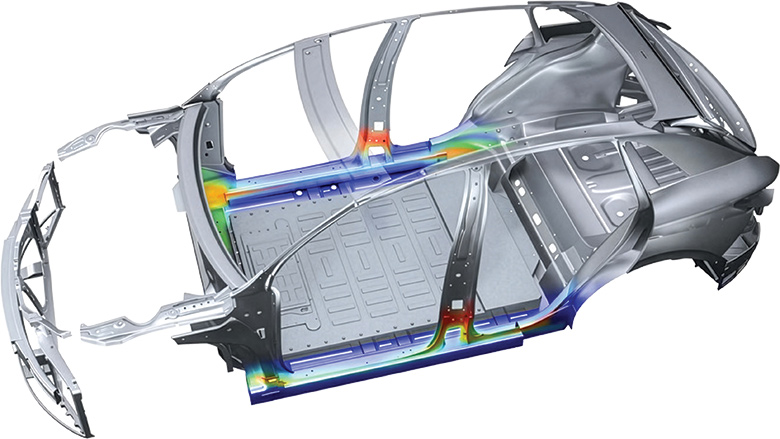
Significantly reinforced side skirts on electric vehicles (highlighted in blue) enhance crash safety and require structurally capable adhesives. Image courtesy of DuPont.
Broad-bake Adhesives
Typical epoxy resin adhesives usually require curing temperatures of 180 °C during cataphoretic coating, but this method hits its physical limits with massive cast aluminum components; thin-walled parts quickly reach the required core temperature whereas large-volume components take considerably more time. This prolongs process cycles, affecting productivity.
One solution to this challenge is a new generation of what are known as broad-bake adhesives. These adhesives can cure reliably starting from a component temperature of just 150 °C yet are also compatible with conventional high-temperature processes. One example is the DuPont™ BETAMATE™ adhesives portfolio, which Bodo Möller Chemie distributes as a long-standing expert partner.
DuPont BETAMATE: “It can be used to cure both thin- and thick-walled components in the same furnace process without extending cycle times, resulting in improved energy efficiency.”
— Bernhard Vreden, key account manager at Bodo Möller Chemie.
This technology also opens up a new scope in cataphoretic coating: Thanks to broad-bake adhesives, manufacturers can now use paints that cure at lower temperatures, starting from 140 °C. This not only reduces energy consumption but also improves sustainability throughout the entire production process. Another breakthrough is improved shelf life stability. Previously, low-temperature adhesives suffered from a limited storage life. Broad-bake systems now offer stable, reliable, long-term performance — a crucial advance for mass production.
Bonding Challenge: Aluminum Meets Steel
As vehicle designs incorporate larger components, requirements are also changing for joining methods. Aluminum cast parts often need to be affixed to steel components, a challenging scenario for materials engineering. Aluminum expands significantly more than steel when subjected to heat, which can lead to considerable stress loads during cooling. In such cases, adhesives not only need to adhere reliably to both materials; they must also be elastic enough to compensate for thermal stresses. Conventional thermal-curing adhesives are unsuitable here since giga cast components are often machined outside the cataphoretic coating process. Structural adhesives that cure at room temperature are used instead, as they combine structural strength with high elasticity.
Digital Development
The optimum design for such adhesive joints is highly complex. Safety, rigidity, and process capability must all be taken into account in equal measures. Bodo Möller Chemie opts for digital development processes, working closely with its customers to find tailored solutions. The finite element method (FEM) is used to simulate adhesive joints between aluminum and steel in a lifelike way, allowing for targeted optimization.
These FEM models deliver precise data about an adhesive’s behavior under mechanical and thermal stress, such as those caused by crash tests, aging effects, or fluctuations in temperature. This allows a bespoke adhesive strategy to be developed during the design concept stage, a clear competitive advantage for vehicle manufacturers and suppliers.
Conclusion
The latest adhesive systems deliver much more than mere joining of components. They allow more efficient production processes, open up new scope for design, and help reduce energy consumption and production costs. In the context of electric mobility, they are a key factor in the advance towards safer, more sustainable, more adaptable vehicle architectures.
Learn more about Bodo Möller Chemie at www.bm-chemie.com. Additional information about DuPont is available at www.DuPont.com/mobility.
This article was written by technical experts at Bodo Möller Chemie.
Looking for a reprint of this article?
From high-res PDFs to custom plaques, order your copy today!