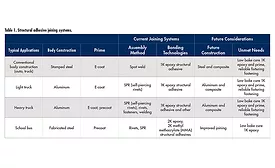
In my 30 years as a senior materials engineering manager with Navistar International, a truck and engine OEM, conventional automotive and truck body manufacturing plants predominantly used 1K epoxy structural adhesives due to their superior bonding performance and manufacturing-friendly properties.
Available through the U.S. Green Building Council’s Leadership in Energy and Environmental Design (LEED®) program, LEED v4 is the newest iteration of a benchmark standard for high-performance green buildings.
Improving customer spending is expected to drive demand for consumer and packaging adhesives and sealants. consumer and packaging adhesives and sealants.
The ChemQuest Group currently estimates the value of the global adhesives and sealants industry at approximately $51 billion, comprised of $44.5 million in adhesives and $6.2 billion in sealants.
I hear many salespeople complain that their product has become commoditized. This can be one of those “perception equals reality” traps; that is, if you believe your product or service is a commodity, then you are helping to make it a commodity.
Coming into 2015, the U.S. adhesives industry looks to continue its recent trend of lower-than-normal volume growth. Historically, adhesives and sealants have been growing about 1½ times of the gross domestic product (GDP) in the U.S.
Business development can be defined several ways. To some people, it is a sales function. Others might see it as a marketing function, and yet others think it involves work with mergers and acquisitions.
As a supplier, imagine knowing that almost any material was bondable. How much more productive would your work be if you could focus on such factors as environmental resistance, structural strength or cure speed?
The outlook for the U.S. adhesives and sealants industry at the mid-point of 2014 has slightly improved over 2013. After growing just 1.9% in 2013, most economists are predicting the U.S. gross domestic product (GDP) will grow 3% for 2014.
 RSS
RSS