Beyond the Bond: Selecting the Right Adhesives for Diverse 3D Printing Materials
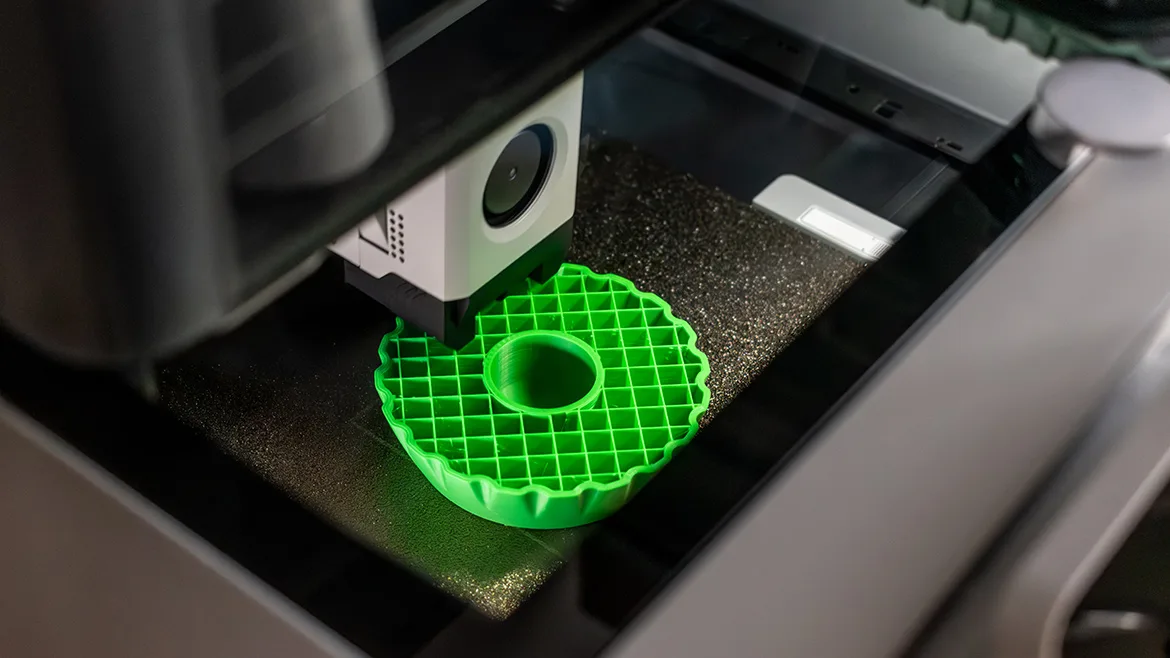
Surface energy in 3D-printed components can vary based on print orientation and post-processing, not just material type.
Need to Know
- 3D-printed substrates introduce new bonding variables, including porosity, layer lines, surface energy, and directional strength.
- Adhesive selection depends on the printed material, with PLA, ABS, nylon, PETG, and photopolymer resins presenting different bonding characteristics.
- Joint design can be as important as adhesive chemistry, particularly when managing stress and weaknesses between printed layers.
- Testing should replicate production conditions, including print orientation, surface preparation, environmental exposure, and aging.
Additive manufacturing has gone from simple prototyping to final-part production. Today, 3D-printed parts are fixtures on factory floors and inside heavy equipment, and they’re also integrated into end-use assemblies that face mechanical and thermal stress and chemical exposure.
For professionals in the adhesives and sealants industry, this represents a significant shift. Rather than bonding plastic, they’re bonding more sophisticated materials: anisotropic structures, variable surface chemistries, materials engineered at the filament or resin level. The challenge goes beyond finding a strong adhesive — it involves selecting the right one for a substrate that doesn’t behave like a traditionally molded polymer.
Why 3D-Printed Substrates Change the Bonding Equation
Unlike injection-molded parts, 3D-printed components introduce layered construction and variable porosity, along with directional strength. Surface energy can vary based on print orientation and post-processing, not just material type.
Here’s what makes 3D printing materials uniquely demanding:
- Layer lines create micro-gaps and capillary pathways that influence adhesive wet-out and penetration.
- Surface energy differs widely between materials like PLA, ABS, nylon, PETG, and photopolymer resins.
- Internal infill patterns affect load distribution across bonded joints.
- Print orientation creates anisotropic strength, meaning the joint may be stronger than the part (or vice versa).
- Post-processing steps — sanding, vapor smoothing, UV curing — alter surface morphology and adhesion potential.
Matching Adhesive Chemistry to Filament and Resin Types
Not all thermoplastics or resins behave the same way at the bond line. PLA and PETG generally offer moderate surface energy and respond well to cyanoacrylates or certain acrylic systems with minimal surface prep. But they can be brittle under impact or elevated temperatures, so adhesive flexibility becomes part of the equation.
ABS presents a different opportunity. Solvent-based systems or reactive acrylics can achieve strong chemical interaction with the substrate. However, printed ABS may have slight surface porosity that can influence cure dynamics and bond consistency.
Nylon creates certain difficulties. Its low surface energy and moisture absorption characteristics can undermine bond strength — unless surface treatment, primers, specialty structural adhesives, or similar products are used. In high-humidity industrial settings, that moisture uptake can influence long-term performance.
Photopolymer resins add another layer of complexity. Some are inherently brittle, while others may retain unreacted surface chemistry after printing and post-curing. Adhesive selection needs to account for potential residual photoinitiators and the final cured modulus.
Material data sheets are a starting point, but real-world print parameters and finishing processes complete the picture.
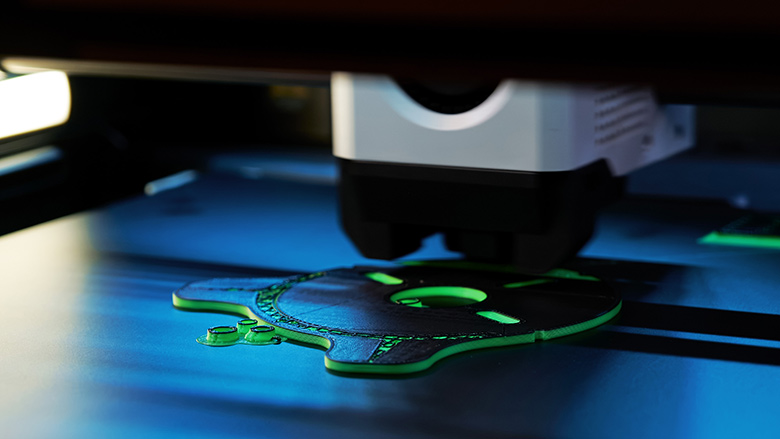
Credit: gleitfrosch / iStock via Getty Images Plus
Surface Energy, Porosity, and Wet-Out: Where Bonds Are Won or Lost
Surface energy is among the most important factors to consider in adhesive selection. If the adhesive can’t properly wet a surface, the rest of the formulation won’t matter. But 3D printing introduces micro-porosity that complicates bonding. In FDM prints especially, tiny voids between layers may draw low-viscosity adhesives into the structure. That can be beneficial for mechanical interlocking — or problematic if it starves the bond line. High-viscosity structural adhesives can bridge layer lines more effectively, but may require surface abrasion to maximize contact area. When there’s significant porosity, cure exotherm and shrinkage also need attention. A rigid adhesive curing within a semi-porous substrate can introduce localized stress concentrations. In these cases, bond performance involves careful stress management and adhesion strength.
Structural Integrity in High-Performance Applications
3D-printed components are now used in jigs, housings, brackets, ducting, and even load-bearing assemblies. In some workflows, they complement or replace parts sourced through traditional custom molding services, especially for short production runs or highly specialized geometries. That offers powerful flexibility, but it also means adhesives need to compensate for the inherent limitations of additive manufacturing. Layer adhesion within the printed part is often weaker than bulk material strength. If a bonded joint is stronger than the interlayer bond, failure may occur within the printed substrate rather than at the adhesive interface.
For structural assemblies, consider:
- The relationship between adhesive modulus and substrate modulus
- Thermal expansion mismatch between adhesive and printed polymer
- Long-term creep under sustained load
- Chemical exposure in the end-use environment
- Fatigue performance across printed layer lines
Adhesives are load-sharing components in a hybrid structure, not just bonding agents, making it important to choose the right type.
Designing for Bonding Instead of Fixing It Later
One common misstep in additive manufacturing is treating bonding as an afterthought. Design engineers may optimize geometry for printability without considering key factors: bond area, joint configuration, and stress distribution. That leaves adhesive professionals solving avoidable problems downstream.
Fillet joints, lap joints, interlocking geometries, and other solutions can improve bond performance in printed parts. Increasing surface area and reducing peel stress, while accounting for anisotropy at the design stage, often matter more than switching adhesive chemistries later.
In some cases, adjusting infill density near the bond region can improve compressive strength and reduce localized deformation under clamping pressure. Overall, the more integrated the collaboration between design, printing, and adhesive selection, the more predictable the outcome.
Testing Protocols for 3D-Printed Bonds
Traditional lap shear tests remain useful, but they don’t always tell the full story for additively manufactured substrates. Testing also needs to reflect real-world conditions and account for variability introduced during printing. Protocols to follow include:
- Print samples in the same orientation as production parts
- Replicate surface preparation steps exactly as performed on the shop floor
- Test across environmental extremes that are relevant to the end-use case
- Evaluate both cohesive failure within the adhesive and substrate failure across print layers
- Monitor aging effects, especially for hygroscopic materials like nylon
Bond strength numbers are only meaningful when they reflect actual production variables.
Bonding as a Strategic Advantage
3D printing is expanding what’s possible rather than replacing traditional manufacturing — and that expansion represents both complexity and opportunity. Printed substrates demand a deeper understanding of surface energy, porosity, anisotropy, and environmental exposure.
With the right approach, adhesives become more than a joining method. They act as a strategic enabler of design freedom and production agility. Selecting the right adhesive for diverse 3D printing materials involves aligning chemistry and process with performance in a way that respects how additive parts are built, rather than just finding the strongest formula on paper. Beyond the bond lies something more powerful: partnership in innovation.
Learn more about RevPart at revpart.com.
Resources:
Moore, G. (2025, Oct. 2). The best adhesives for bonding 3D printed parts. Fastening&Bonding.net. https://www.fasteningandbonding.net/the-best-adhesives-for-bonding-3d-printed-parts
Campilho, R. (2025, Jan. 22). Advances in Adhesive Bonding Techniques for 3D-Printed Components. Clareus Scientific Science and Engineering. https://clareus.org/pdf/csse/CSSE-02-006.pdf
(2025 July 8). Best Glue for PLA: Guide to Bonding 3D Prints. Snapmaker. https://www.snapmaker.com/blog/best-glue-for-pla-3d-prints/
(2024, Oct. 11).. How to Glue 3D Prints: A Complete Guide for Seamless Connections. JLC3DP.COM. https://jlc3dp.com/blog/3d-print-glue-complete-guide
Moore, G. (2025, Oct. 2). How to bond 3D printed parts. Permabond Engineering Adhesives. https://permabond.com/how-to-bond-3d-printed-parts/
Looking for a reprint of this article?
From high-res PDFs to custom plaques, order your copy today!